


13 Feb Bad Bunny at Super Bowl LX: symbols and references
It wasn’t “just” a show: Bad Bunny’s Super Bowl LX half-time was designed as a living postcard of Puerto Rico and, at the same time, as a journey through the Latino neighbourhoods of the United States, with everyday objects serving as symbols (street food, dominoes, chairs, commercial signs) and nods to music, migration and social commentary. Today, we explain, with the help of images, the symbols and references in Bad Bunny’s Super Bowl LX performance: Puerto Rico, the neighbourhood, music, the diaspora and the social message.
Because at ELE USAL Strasbourg, we love this type of cultural reading: understanding what we see is a direct way to learn Spanish in context (and not just grammar).
The opening: sugar cane and jíbaros (roots)
The first large image places history before spectacle: it shows sugar cane and a group of performers dressed in traditional white costumes and pava, associated with the figure of the jíbaro, the traditional farmers of Puerto Rico. Why start there? Because sugar cane is the symbol of the Caribbean’s economic origins, but also of its colonial history: wealth built on forced labour, on the hands that cut this cane under the relentless sun for centuries.
It is a way of saying ‘it comes from the land’, from an economic and social past that continues to influence the present.


Spanish on the most popular stage
From the outset, the staging emphasises Spanish (including the presentation of the artist with his name) as the central language of the narrative. In a global event, this functions as a gesture of identity: it is not a “translation”, it is a presence.

Coco frío: street, heat and memory
Then comes what is known in Puerto Rico as a ‘coco frío’: coconut water served directly from the fruit, rather than from a carton bought at the supermarket. It’s a scene that anyone who has ever lived in the Caribbean will immediately recognise: heat, beach, street corner, street vendor.

Dominoes: screen-free community
The dominoes table (a social classic throughout Latin America and the Caribbean) is not just a piece of furniture: it is a place for meeting, discussion, neighbourhood life and intergenerational sharing. That is why it works so well as a symbol: it tells the story of a culture without saying a word.

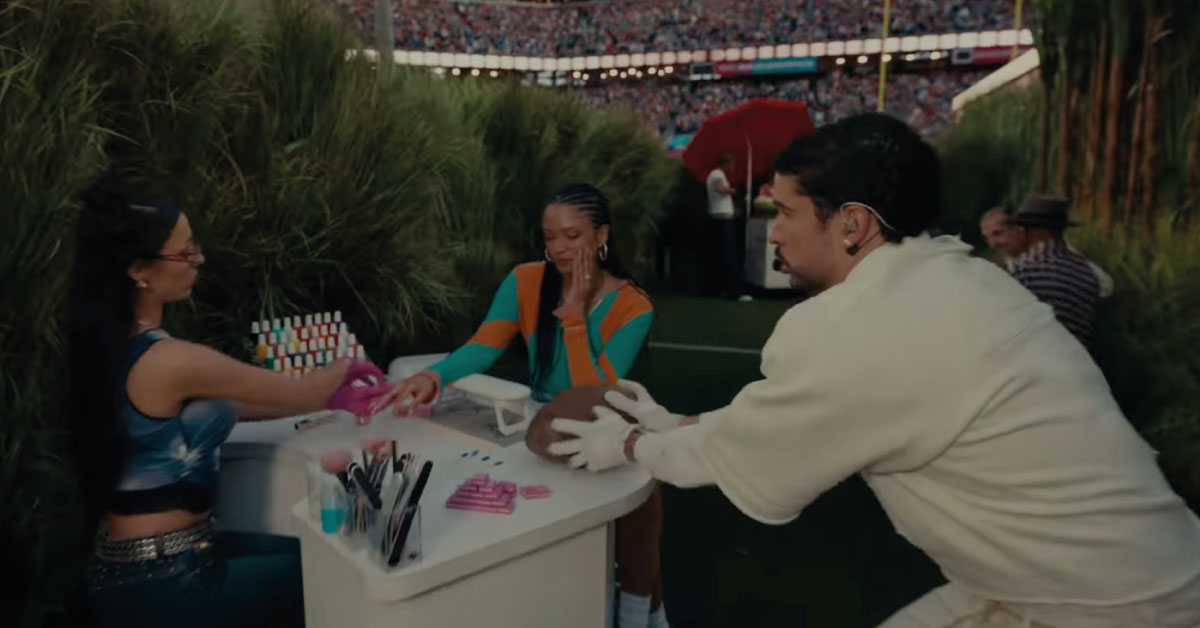
Manicure salon: aesthetics and everyday life
The nail salon appears to be a nod to a social custom, but also to an economic and cultural reality that is very recognisable in many Latin American communities.
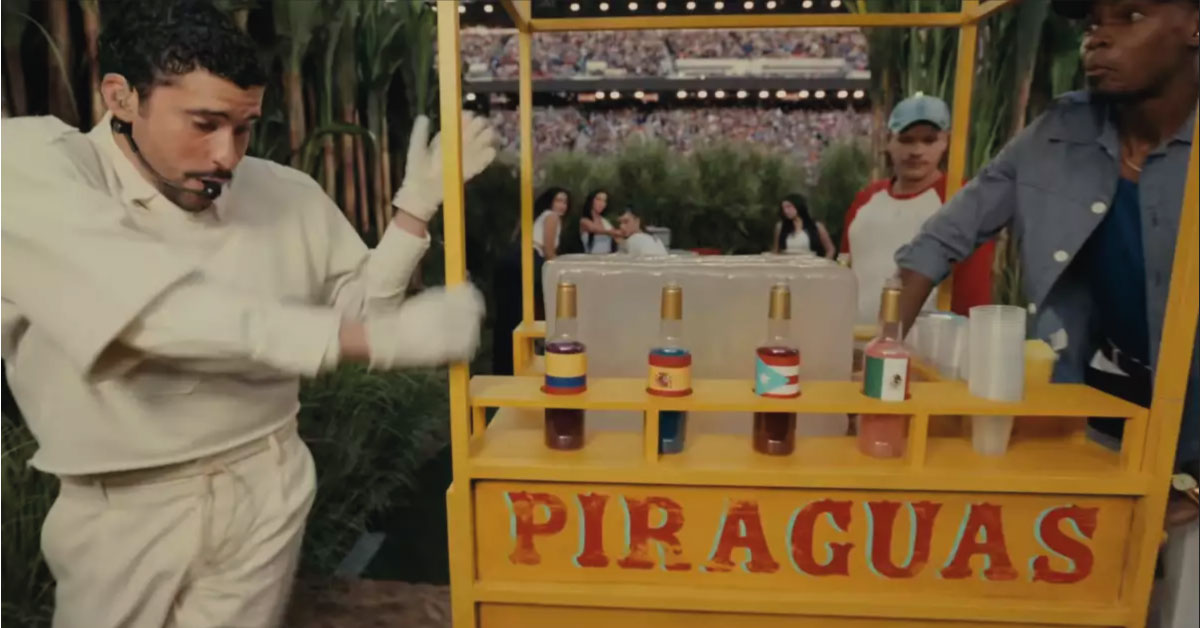
Piraguas: a dessert that lives up to its name
Piraguas (crushed ice with syrup) are a very Puerto Rican detail, and you can also see bottles with flags (Mexico, Puerto Rico, Spain, Colombia). The message is simple: Latin culture is diverse and blends together in everyday life (even in ‘flavours’).
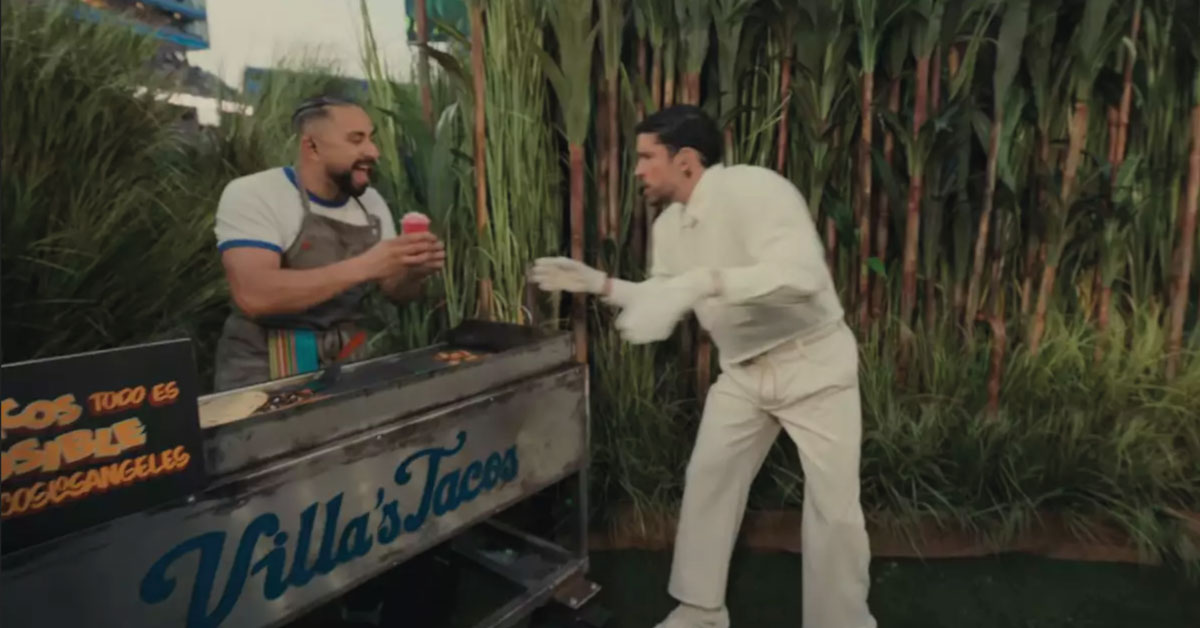
Villa’s Tacos: Mexico seduces with its cuisine
The appearance of Villa’s Tacos serves as a concrete reference to Mexican and Mexican-American culture, transposed into a very real scene: eating, shopping, naming the place. This reminds us that the series does not deal with ‘Latino identity’ in an abstract way, but through recognisable elements.
It may seem chaotic if you don’t know the context, but every detail has a purpose. These are not ‘folkloric ornaments’. This is everyday life for millions of people. The street is a place for meeting, conversation and informal economic activity. Dominoes isn’t just a game: it’s an excuse to get together. The improvised nail salon isn’t a sign of poverty, but of creativity and community.
For someone who has never set foot in a Latin neighbourhood, this scene is a window into another world. For someone who has, it is a mirror. And that is where the magic lies: Bad Bunny manages to make both feel included.
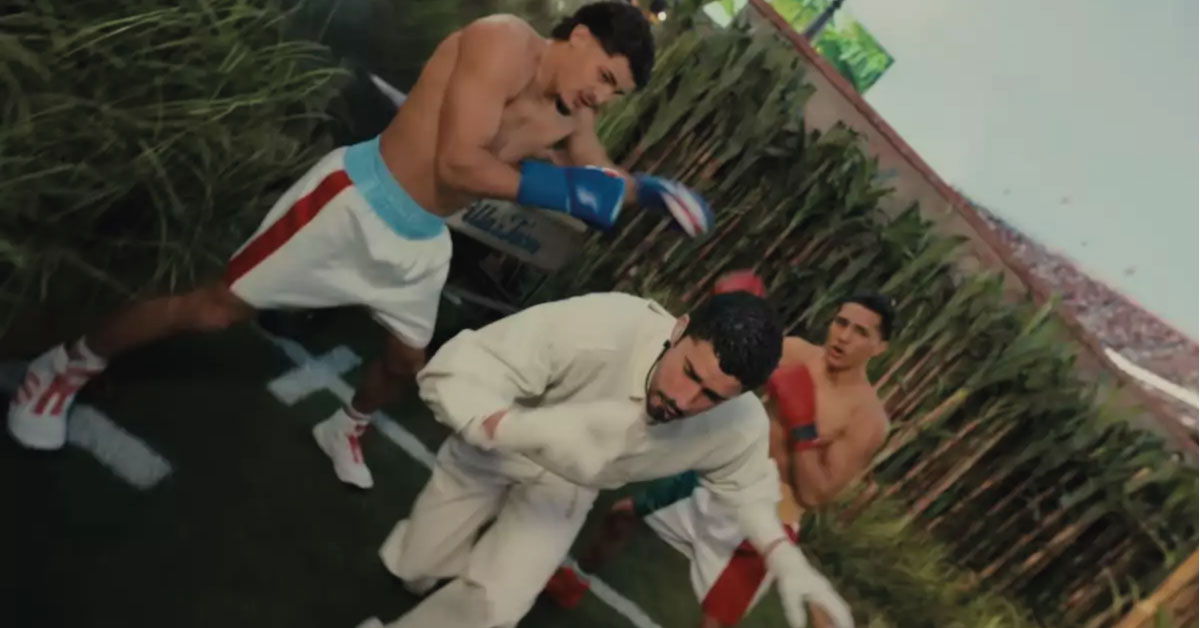
Boxing: discipline and rivalry between Mexico and Puerto Rico
One of the most talked-about appearances is that of boxing, with Xander Zayas (Puerto Rican) and Emiliano Vargas (Mexican-American) practising shadowboxing. Here, the symbol is not violence: it is discipline, pride, sporting history and the cultural rivalry between Mexico and Puerto Rico in the ring, translated into visual language.
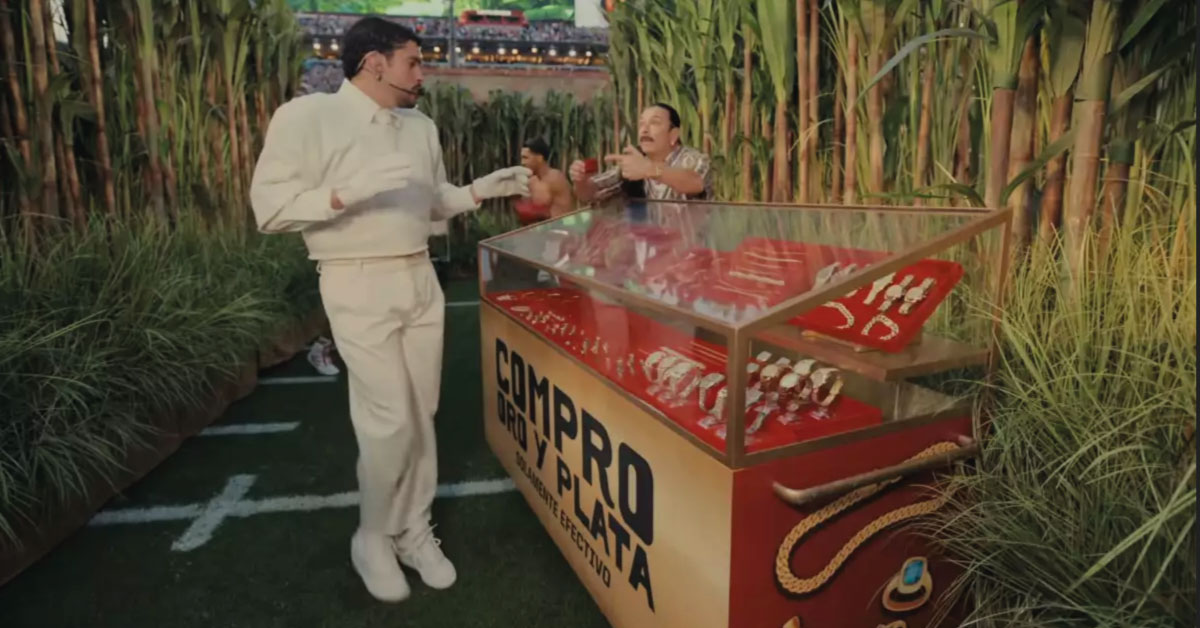
‘I buy gold and silver’: popular economy (and the ring)
The sign ‘compro oro y plata… efectivo’ (‘I buy gold and silver… cash’) is a very common sight in cities. In this context, the gesture of offering and then refusing an engagement ring adds a mini-story about value, desire and transaction (what can be bought, what cannot be bought).
The casita (little house): entering the origin (literally)
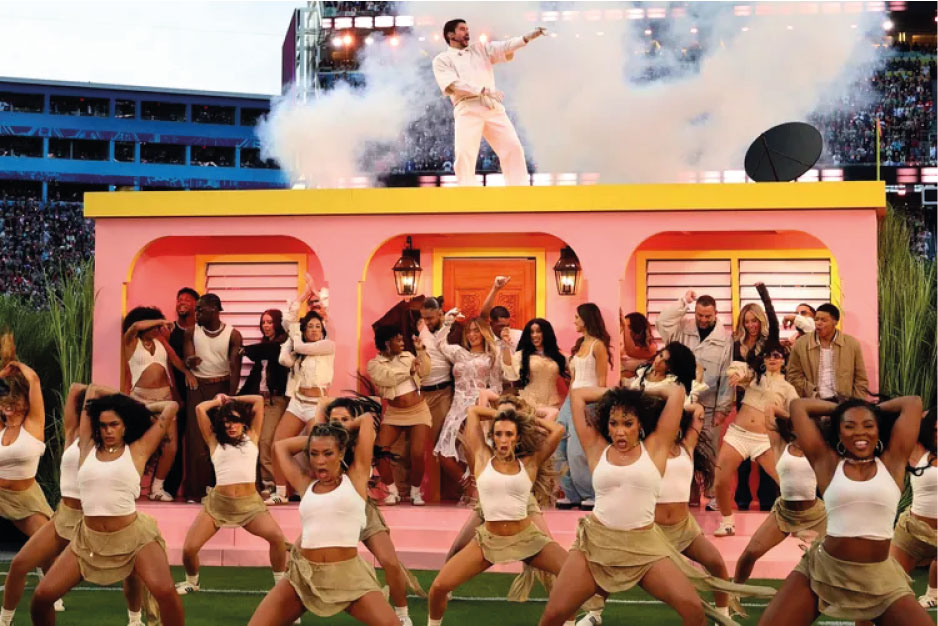
Then something appeared that many immediately recognised: the casita (the little house). A small cement house, painted pink, placed in the middle of the stadium as if it were the most normal thing in the world.
This little house is not just any house. It is a symbol that Bad Bunny had already used during his Debí tirar más fotos tour, representing the traditional Puerto Rican home: humble, concrete, real. What he does here is powerful: instead of hiding his origins to “fit in” with the most American show of the year, he puts them front and centre.
And it’s not empty. Guests such as Cardi B ( from the Dominican Republic) ), Karol G ( from Colombia ), Pedro Pascal ( from Chile ) and other Latin personalities appear on the porch of the small house. The house becomes a meeting place, a symbol of hospitality and shared pride. It’s like saying, ‘This is my house, and everyone has a place here.’
Maga flower: the Puerto Rican Easter egg
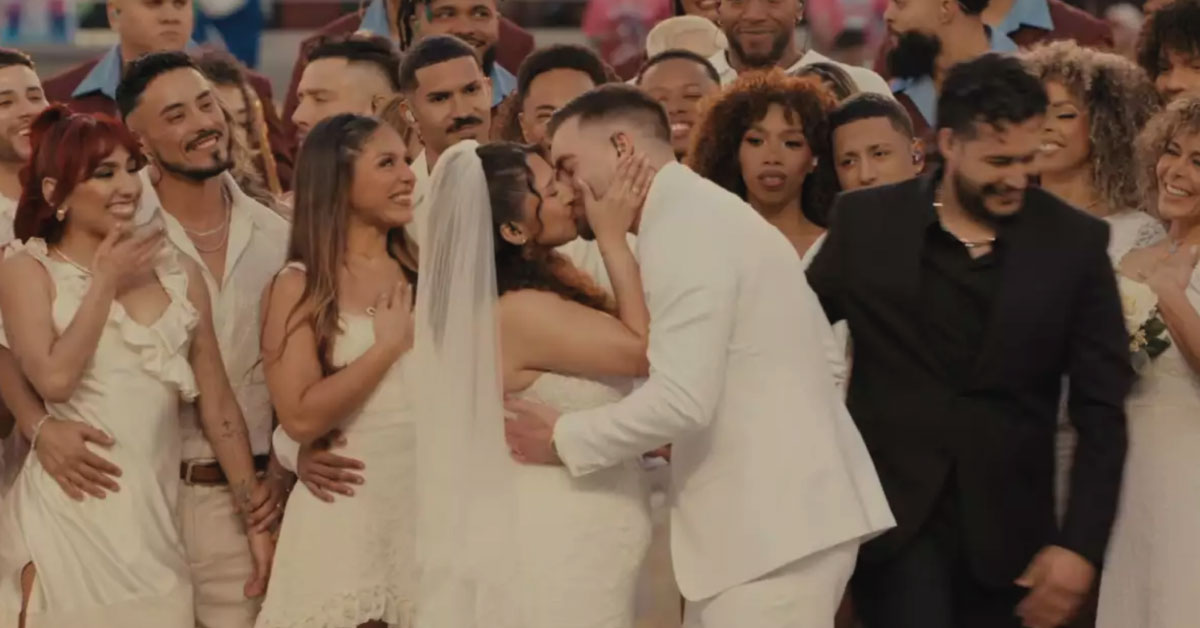
Suddenly, the party in the little house turns into a real wedding celebrated on stage. And that’s when Lady Gaga makes her appearance. But this isn’t the usual pop star Lady Gaga, but a Lady Gaga who blends in with the island’s aesthetic.
She wears a light blue dress (once again, the colour blue evoking independence) and, on her chest, a huge brooch in the shape of a red flower. This flower is not just a simple ornament: it is the maga flower, the national flower of Puerto Rico. At a global event where everything is measured down to the last millimetre, the fact that an American star wore the island’s floral symbol on her chest was a gesture of respect and cultural alliance. Gaga was not there to ‘steal the show’, but to honour the place where she was singing.
Marriage: two cultures in one ritual
The wedding scene is presented as a symbol of cultural union, and the most interesting thing is that it was a real wedding (and not just a staged event). In the narrative, this detail is important: the show tells you ‘this is really happening’ within the show itself.
Sleeping child and ball: childhood in the Latin way
Bad Bunny wakes up a child who has fallen asleep in a chair; this scene echoes an experience common to many families: long parties, adults chatting, exhausted children. The American football in his arms combines America and family.

Reggaeton and salsa: two genealogies in the body
The show combines reggaeton and salsa as languages of dance and musical history. There is no need to “explain” it theoretically: it can be seen in the energy, the posture, the type of movement and the audience’s reaction.

La Marqueta and the shops: the neighbourhood as a backdrop
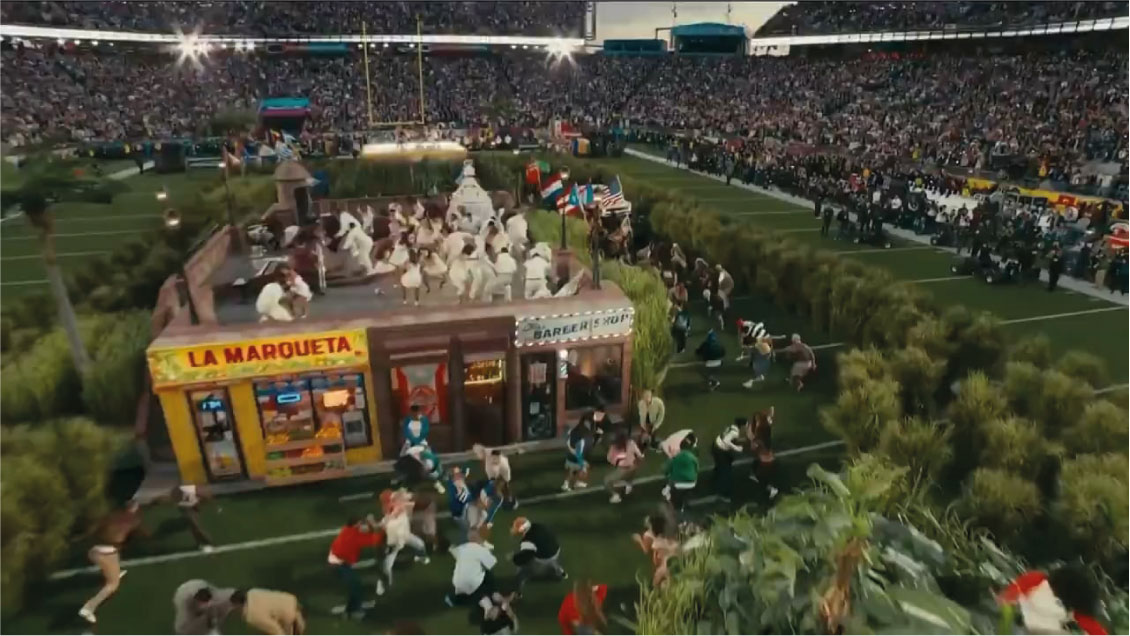
The setting transforms into a small shopping district with a barber shop, a liquor store and La Marqueta supermarket, associated with New York’s Puerto Rican community. This neighbourhood is almost a lesson in urban culture: signs, names, shops and sociability as identity.
Toñita: when a real person represents a community
At one point in the show, Bad Bunny walks through a set that replicates a New York street and enters a bar to have a drink served by an elderly woman: Toñita. For those who don’t know her, this may seem like a simple cameo. But that’s not the case.
Toñita is María Antonia Cay, fondatrice du Caribbean Social Club in Williamsburg, Brooklyn, a bar that has been open since the 1970s and has become a refuge and meeting place for New York’s Puerto Rican community. The set of the show was an exact replica of the real bar, with the address ‘244 Grand St.’ visible on stage.
Why is this important? Because Puerto Rico isn’t just on the island. Puerto Rico is also in New York, Orlando, Chicago. It’s wherever people had to go to find work, to build a better life for themselves, without forgetting where they came from. Toñita represents the diaspora: that part of identity that is lived outside, but remains authentic. And in a neighbourhood like Williamsburg, where gentrification has wiped out so many Latino spaces, the fact that this bar is still there (and appears in the Super Bowl) is an act of cultural resistance.

The Grammy Awards child: identity and clarification of the rumour
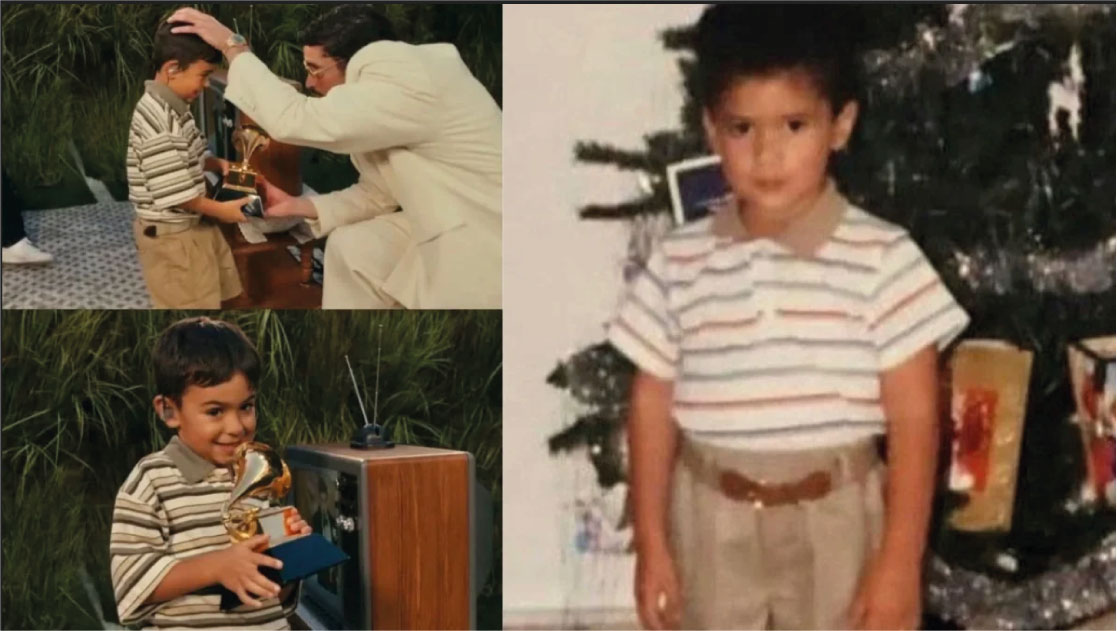
It is important to be precise here: the child receiving the Grammy is Lincoln Fox, a 5-year-old actor, and that his costume was a replica of Bad Bunny’s when he was little. The symbolism is clear: success returns to its origins, as if to say to ‘the child that I am’ that he has not lost his way.
The cuatro: identity can also be heard
The Puerto Rucan cuatro, an emblematic instrument, appeared at a time of musical transition. It reminds us that a symbol is not always an image: sometimes it is a sound, a string, a musical tradition.

Plastic chairs: the most universal object in the playground
Then another legend appears: Ricky Martin. But he isn’t dancing to Livin’ la Vida Loca. He appears sitting on a white plastic chair, like the ones found at every neighbourhood party in Puerto Rico, in front of banana trees.

The song he performs is essential: Lo Que Le Pasó a Hawaii (What Happened in Hawaii). The lyrics are perhaps the most political of the evening. They talk about gentrification: the fear that Puerto Rico will become a ‘tourist paradise’ where locals can no longer afford to live, as has happened in Hawaii. There are lines such as ‘They want to take my river and my beach too’.
Seeing Ricky Martin, the global idol, singing about climate change and property prices while sitting on a cheap plastic chair sends a powerful visual message: ‘We may be stars, but we still care about what is happening to our planet.’
‘The power cut’: when entertainment becomes social commentary
Next comes one of the most intense scenes. Dancers climb electricity poles while sparks fly, all to the song ‘El Apagón’. To an outsider, this may seem like nothing more than a visual spectacle. To a Puerto Rican, it is much more than that.
‘El Apagón’ refers directly to the power cuts that have affected the island for years, particularly after Hurricane Maria in 2017, which left Puerto Rico without electricity for months (the longest power cut in US history). And the problem has not been solved: power cuts remain frequent, and complaints against the electricity company LUMA Energy are constant. sont constantes.
In a previous interview, he said: ‘Puerto Rico is the only place where I have to install 15 industrial generators because I don’t trust the power grid.’ These sparkling electricity poles are therefore not just aesthetic: they are an expression of anger, a denunciation, a reminder.

The Concho toad: pop + biodiversity
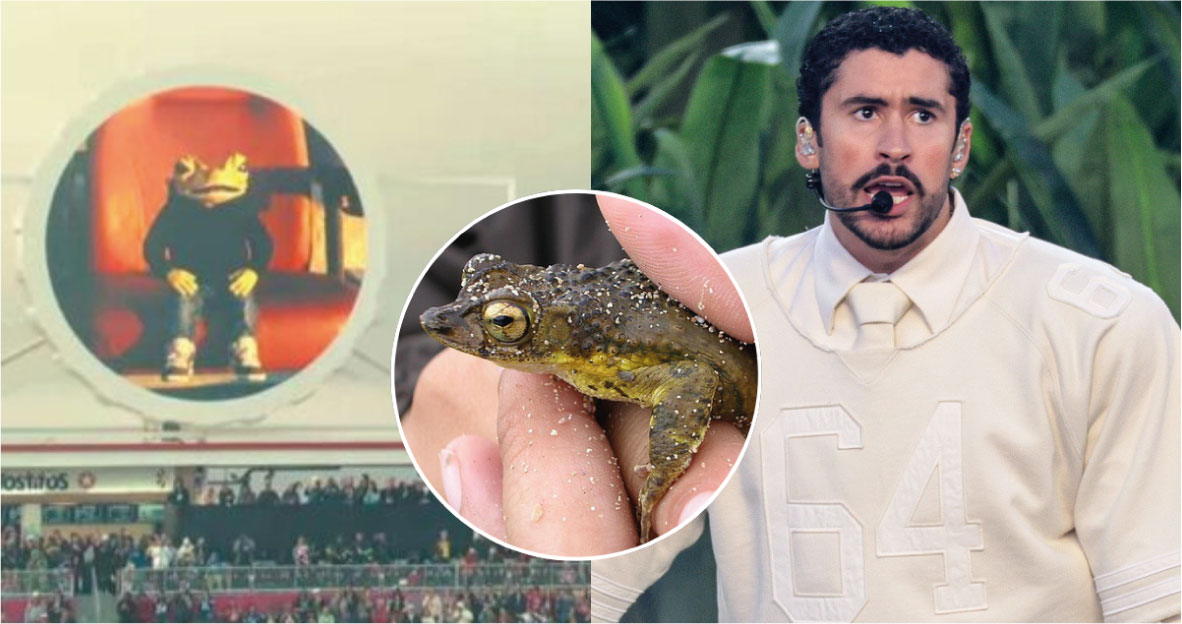
The Concho toad appears as the mascot associated with the album; it is also the only toad native to Puerto Rico and is endangered. It is an unexpected and very effective symbol: it makes you talk about territory, nature and protection through a pop icon.
The flag (and why colour matters)
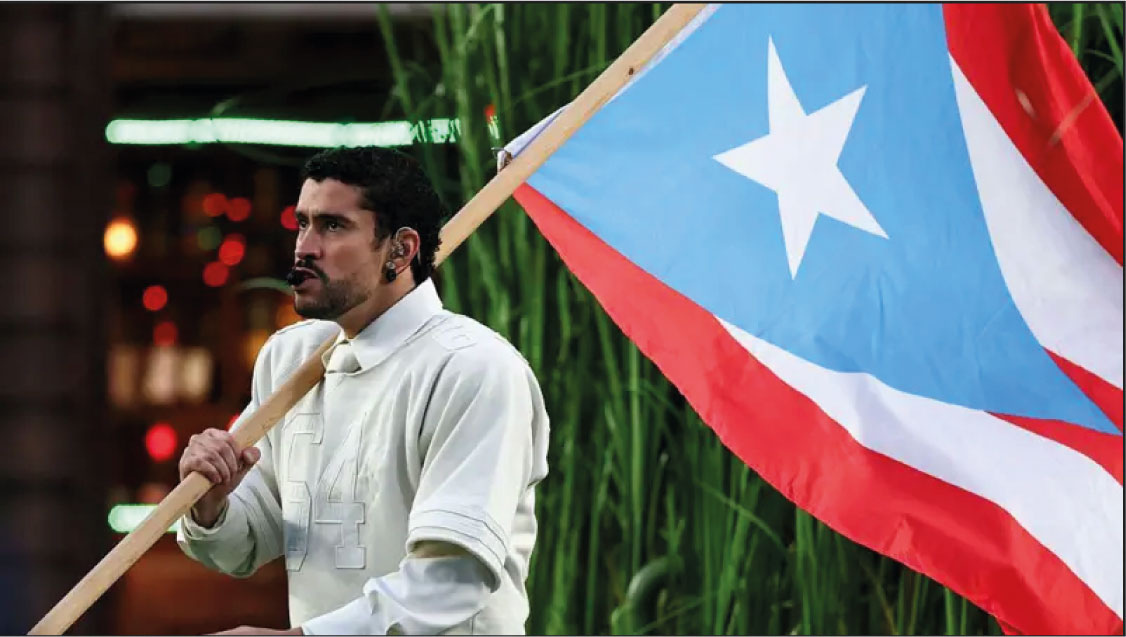
At several points during the show, the flag of Puerto Rico appears. But not just any flag: the one shown is light blue, not dark blue like the official version.
Why is this important? Because Puerto Rico’s original flag was sky blue, and this colour was associated with the independence movement. When the United States took control of the island, the blue was darkened to match that of the American flag. Today, for many, using light blue is a way of reclaiming this history and their own identity.
Not everyone “reads” this detail. But for those who do, it sends a very clear message.
The conclusion: ‘Together, we are America.’
The show ends with Bad Bunny shouting ‘God bless America’ while the flags of all the countries of North America, Central America and South America flash across the screens: Chile, Brazil, Mexico, Canada, the United States, Puerto Rico… He holds an American football in his hands with the words ‘Together, We Are America’ written on it.
This is undoubtedly a political conclusion. Because it redefines what “America” means. It is not just the United States. It is an entire continent, with dozens of countries, cultures, languages and shared experiences.
And one last sentence appears on the screen: ‘The only thing more powerful than hate is love.’ In a context where debates on immigration, borders and policies towards Puerto Rico and Latin America are more polarised than ever, this message does not go unnoticed.
Indeed, it did not go unnoticed. Donald Trump publicly criticised the performance, calling it an ‘affront to the greatness of America’. And Republican lawmakers asked the FCC (Federal Communications Commission) to investigate the content of the programme. These reactions confirm that the message was perfectly understood.

Why is all this important?
Because Bad Bunny didn’t ‘just’ sing. He used the most watched stage of the year (135 million viewers) to teach, to make a statement, to show that culture is not something to be displayed: it is something to be experienced.
And he did it without translation. Almost the entire show was in Spanish. No apologies, no adaptations, no ‘making things easier’ for the English-speaking audience. Because the message was precisely this: ‘This is who I am, this is what belongs to us, and it deserves to be here as it is.’
For students of Spanish (and for anyone who wants to better understand the Hispanic world), this show is a real lesson in culture, history, politics and pride. And the best part is that all of this is hidden in a show that also combines music, dance, light and emotion.
Because that’s how culture works: it touches you without you even realising it. And when you least expect it, you’re already learning.
Would you like to better understand these cultural references while learning Spanish? At ELE USAL Strasbourg, we design our courses so that the language is always accompanied by real-life context: history, current events, music, cinema, and everything else that makes Spanish a living language. Because learning a language is not just about learning grammar: it’s about understanding how an entire community thinks, feels and expresses itself.
Want to see Bad Bunny’s entire performance? Here’s the link: Super Bowl halftime show featuring Bad Bunny on Apple Music.
Mini cultural glossary (to take home with you):
– Jíbaro: traditional Puerto Rican peasant; symbol of rural identity and local pride.
– Diaspora: community living outside its territory of origin; in this case, Puerto Ricans in New York and other cities in the United States.
– Piragua: crushed ice with coloured syrup; icon of the Caribbean street.
– Apagón: power cut; in the show, a symbol of the energy crises in Puerto Rico.
– Gentrification: transformation of neighbourhoods that drives out original residents due to rising prices; mentioned in relation to Williamsburg.
– Sky blue flag: independence version of the Puerto Rican flag, as opposed to the official dark blue.
No Comments