


01 Feb Cabeza de Vaca, the Spanish explorer who defied the impossible
A tale of survival, transformation and discovery that forever changed America’s understanding. This is the story of Álvar Núñez Cabeza de Vaca.
A name that resonates throughout history
When we study Spanish in Strasbourg, or anywhere else in the world, one of the most fascinating stories we can discover is that of Álvar Núñez Cabeza de Vaca, a 16th-century Spanish explorer whose odyssey for survival rivals the most exciting adventure novels ever written.
His name, Cabeza de Vaca, has an origin as poetic as it is legendary: in 1212, during the Battle of Las Navas de Tolosa (a decisive moment in the Spanish Reconquista), a shepherd named Martín Alhaja, guided Christian troops through dangerous territory, marking the path with the skulls of cows recently devoured by wolves. King Alfonso VIII, as a sign of gratitude, created a noble lineage around this feat. Eight centuries later, this same surname would be borne by a man whose adventures in America would immortalise him in the annals of world exploration.
At ELE USAL Strasbourg, we believe that learning Spanish is not just about learning verb conjugations and vocabulary, but also about connecting with the rich culture, history and extraordinary stories that have shaped the Spanish-speaking world. The story of Cabeza de Vaca is one of those fascinating bridges between the language you are studying and the epic tales that Spaniards have passed down over the centuries.
Join us on this journey of discovery.
A Castilian nobleman in troubled times (1488–1527)
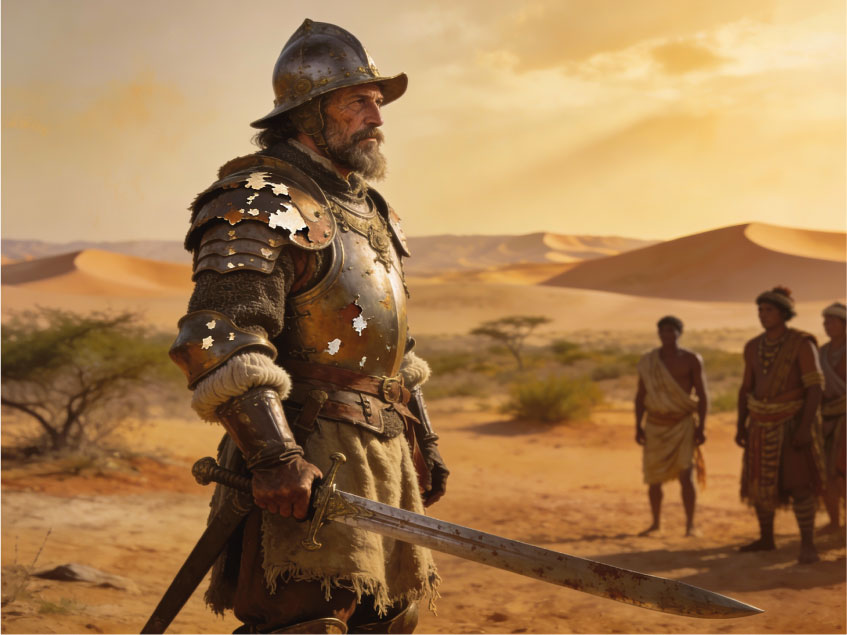
Álvar Núñez Cabeza de Vaca was born between 1488 and 1495 in Jerez de la Frontera, Cádiz, a border town in Andalusia which, during his childhood, was still experiencing tensions due to its proximity to the Muslim kingdom of Granada. His ancestors were not minor conquistadors: his paternal grandfather, Pedro de Vera, was one of the most prominent conquistadors in the Canary Islands and a figure of considerable importance at the court of the Catholic Monarchs.
Raised in a noble military family, Cabeza de Vaca was trained in warfare and service to the Crown. His first trial came in 1512, when he enlisted in the royal army to fight in the Battle of Ravenna, one of the bloodiest battles of the Italian Wars. This battle, which claimed around 20,000 lives, left a lasting impression on the young officer, introducing him to the full cruelty of war.
After Italy, he served against the French in the territories of Navarre and actively participated in the suppression of the Comuneros revolt (1520-1521), a revolutionary movement that threatened the centralised power of the Spanish Crown under Charles V. By 1527, Cabeza de Vaca was an experienced officer loyal to the Crown, with the rank of treasurer and chief usher, a trusted man ready to take on greater responsibilities.
What he did not know was that his real ordeal was about to begin.
The Narváez expedition: dreams of conquest (1527–1528)

On 17 June 1527, Cabeza de Vaca set sail from the port of Sanlúcar de Barrameda (the same port from which Christopher Columbus had set sail a few decades earlier) as part of Governor Pánfilo de Narváez. The fleet consisted of approximately 600 men, five ships, and an ambitious goal: to conquer and colonise Florida, a virgin territory for Spain, full of promise of gold, fertile land, and indigenous people to convert to the Christian faith.
Narváez was a controversial veteran of the Americas, having served in Cuba and La Española (Santo Domingo). What he lacked was reliable information. The maps of the time were approximate, if not completely inaccurate. The actual geography of the Gulf of Mexico remained a mystery to the Spanish.
The first disaster: shipwreck in Saint-Domingue

The journey began with misfortune. In Santo Domingo, while Cabeza de Vaca was part of a special commission tasked with procuring supplies, two ships on which they were travelling sank in an unexpected storm, killing 60 men and 20 horses. For Cabeza de Vaca, this was his first encounter with the destructive power of the ocean, but it would not be his last.
After spending the winter in Cuba (where there were mass desertions), the expedition finally set sail for Florida. On 12 April 1528, it landed near what is now the city of Tampa, on the coast of Florida. What followed was a series of disastrous decisions that would decimate the expedition.
The fateful decision: separation of ships
After exploring the coast for weeks with discouraging results (attacks by local indigenous populations, famine, mysterious diseases), Narváez made a decision that would change the course of history. In September 1528, with the ships battered by hurricanes and food running low, the governor decided to build makeshift barges from available materials in an attempt to sail to New Spain (Mexico).
Cabeza de Vaca later reported that he publicly protested against this order. According to his own notes, he argued that abandoning the ships was reckless and foolhardy. However, his protest was ignored. The men built boats with whatever they had at hand: wood, skins and makeshift ropes.
The barges sank almost immediately in another hurricane near Galveston Island, Texas. Of the approximately 600 men who made up the original crew, only 80 survivors managed to reach the Galveston coast. The others drowned or were separated, including Governor Narváez, whose fate remains unknown.
Eight years among the natives: from slave to shaman (1528–1536)

What followed is one of the most remarkable survival stories in the history of global exploration.
The 80 survivors in Galveston faced their first winter in catastrophic conditions. Two local indigenous tribes, probably subgroups of the Karankawa provided them with shelter. But the death toll was devastating. Unknown diseases, relentless cold, extreme famine: only 15 of the original 90 shipwrecked survivors lived to see the spring of 1529.
Cabeza de Vaca was one of the survivors, but he was weakened by illness. While others attempted to flee inland in search of New Spain, he remained behind, becoming, in a sense, a slave to the Karankawa natives.
From slavery to trade
During the early years, Cabeza de Vaca’s survival strategy was ingenious: he reinvented himself as a peddler or travelling merchant. He travelled between tribes, trading manufactured goods — shells (used for cutting plants), combs, bows and arrows — for food and safety.
This trade gave him limited but crucial mobility. The indigenous people did not consider him a prisoner in the strict sense, but rather a participant in an economic system they understood. The fact that such a foreign man — with his long hair, unkempt beard and reddened skin — could fulfil an economic function made him, in a way, a full member of the community.
Transformation: the messianic healer
But everything changed when Cabeza de Vaca and his companion Alonso del Castillo Maldonado began practising acts of healing.
This is where the story borders on the miraculous. The two Spaniards performed:
– Prayers to the Christian God
– Making the sign of the cross on diseased organs and bodies
– Laying on of hands
– In one exceptional case, surgery on the tribal chief who had captured them
According to documents from the time, they incised the chief’s chest, presumably removed the diseased tissue, sutured the wound, and, surprisingly, the patient recovered. This event is now recognised as the first documented surgical procedure on North American soil.
Was it a genuine remedy or a ritualistic performance? Probably both. The important thing is that it worked. Cabeza de Vaca’s reputation was radically transformed. From a disposable prisoner, he became a quasi-messianic figure, a shaman with extraordinary healing powers.
Entire families travelled from afar to benefit from his healing powers. He received many gifts: clothing, food, valuable items. His social status rose considerably. He was no longer a slave, but an intermediary between the world of mortals and that of immortals.
The inner journey: two thousand kilometres on foot
After spending about seven years in coastal villages, Cabeza de Vaca and his companions decided to attempt one last escape. They headed inland, walking west and south-west. Over the next two years (1534–1536), they travelled about 2,000 kilometres, crossing:
– Coahuiltecos territories (more than 200 related tribes in inland Texas)
– New Mexico
– Arizona
– Sonora and Sinaloa (north-western Mexico today)

It was a journey marked by utter desolation. The three Spaniards (Cabeza de Vaca, Alonso del Castillo Maldonado and Andrés Dorantes de Carranza) and their companion Estevanico, a Moorish slave of North African origin, were extremely thin, their clothes in tatters, their feet bleeding. But their reputation as healers preceded them. Indigenous peoples came from far and wide to be treated by these legendary figures.
The return to Western civilisation (1536–1540)
In 1536, after eight years of absence from the Spanish world, the four survivors reappeared in San Miguel de Culiacán, in the state of Sinaloa, a territory controlled by the Spanish. The authorities were stunned. An expedition that had been presumed lost, an expedition that almost everyone thought had perished in the desert, had reappeared in an almost supernatural manner.
They were transferred to Mexico City, where they presented their reports to viceroi Antonio de Mendoza. The story they told was extraordinary: unknown territories, detailed ethnographic observations, information about complex indigenous populations, sightings of unknown animals (the first buffalo ever described) and descriptions of a land that seemed to hold potentially valuable resources.
Cabeza de Vaca, now famous in New Spain, sought to capitalise on his experience. He wrote a detailed account addressed directly to Emperor Charles V, in which he described his adventures, emphasising both the extraordinary dangers he had faced and the opportunities offered by America.
Estevanico, the Moorish slave who had survived with the other three, was then hired as a guide on an expedition led by Fray Marcos de Niza in search of the legendary ‘Seven Cities of Cíbola’. Unfortunately, he died in 1540 in Hawikkuh (a Zuni village in New Mexico), presumably murdered by indigenous people. However, his legacy lives on: he is now recognised as the first documented African on North American soil, a historical significance that was forgotten for centuries.
The book that changed European geography (1542–1555)

Discovering the Iguazú Falls
While sailing down the Iguazú River in brigantines built along the way, Cabeza de Vaca suddenly came upon a breathtaking natural spectacle: enormous waterfalls plunging from a height of over a hundred metres, creating a deafening noise and columns of spray rising into the sky.
It was the Iguazú Falls.
Cabeza de Vaca described them in terms that still resonate today:
“The river leaps over very high rocks, and the water strikes the ground with such force that it can be heard from far away; and the foam from the water, falling with such force, rises more than two spear lengths high”.
He was the first European to document the discovery of one of the world’s most extraordinary natural wonders. Of course, the indigenous Mbya-Guaraní peoples had known about them since time immemorial, but Cabeza de Vaca was responsible for making them known to the European world.
He arrived in Asunción on 11 March 1542 and found the city in chaos. The death of the previous governor, rivalries between Spanish captains and extreme abuses committed against the indigenous populations had plunged the colony into crisis.
Governance: a man ahead of his time
What Cabeza de Vaca did next was revolutionary. He attempted to enforce the Laws of the Indies, royal statutes that theoretically protected the rights of indigenous peoples but were rarely seriously enforced in the colonies.
His reforms included:
– Prohibition of physical and verbal abuse of indigenous peoples
– Elimination of forced polygamy
– Regulation of encomiendas (forced labour system)
– Pacification through diplomacy rather than military violence
This inevitably led to a massive conflict with the Spanish colonists, whose wealth depended on unrestricted exploitation. A captain named Domingo Martínez de Irala led the rebellion against Cabeza de Vaca.
In 1544, after only two years as governor, Cabeza de Vaca was arrested for abuse of power. He was sent to Spain to be tried before the Council of the Indies. Although the initial sentence was exile to Oran (a Spanish enclave in Africa), it is unclear whether it was carried out. What is known is that Cabeza de Vaca spent his last years fighting to restore his honour, committing his personal assets to his legal defence.
Publications: survival literature

During this time, Cabeza de Vaca wrote. In 1542, he published his first account, entitled “La Relación y Comentarios”, (The Account and Commentaries), addressed to Emperor Charles V, in Zamora. This book contained the only high-quality European account of Narváez’s expedition and quickly became a reference work on contacts between Europeans and indigenous peoples in North America.
In 1555, during his legal defence in Paraguay, he published a second expanded edition in Valladolid, which included a new appendix entitled ‘Comments’ recounting his experience as governor of Paraguay. This book was, in many ways, a political defence, an attempt by Cabeza de Vaca to present his own version of events and restore his reputation.
What is fascinating is that Naufragios y comentarios is a truly unique work. It is not simply a historical document, but also a literary creation deliberately designed to persuade, justify and defend itself politically. Modern historians have analysed it as an example of what is known as an “anti-conquest narrative”, i.e. a narrative that justifies European imperial expansion while distancing itself from the violent rhetoric of conquest.
However, this does not detract from its value. On the contrary: the ethnographic details are accurate, the observations on indigenous peoples are respectful and detailed, and the geographical information has been verified by subsequent explorers.
The last question
Álvar Núñez Cabeza de Vaca died in Valladolid between 1556 and 1559, years after his reputation in the Americas had been destroyed, years after he had been arrested and exiled, years after his reforms had been overturned by others seeking to get rich quick through exploitation.
Was he a hero? Was he a villain? Was he a humanitarian or an agent of the colonial empire?
The answer is: he was a complex human being who lived in troubled times, made important choices, was transformed by his experiences, and attempted, albeit imperfectly, to live according to the principles of justice and humanity.
His story reminds us that the past is not black and white. That exploration, conquest and the meeting of cultures are complex subjects that deserve careful consideration. And that extraordinary stories of survival, transformation and human redemption remain eternally relevant.
At ELE USAL Strasbourg, we believe that learning Spanish means learning how to access these stories, understand them in their original language, and connect with the depth of the culture that produced them.
Connect to the richness of the Spanish-speaking world
If the story of Álvar Núñez Cabeza de Vaca has inspired you to deepen your knowledge of Spanish language and culture, ELE USAL Strasbourg is the place for you.
We offer:
– Spanish courses for all levels (A1-C1)
– CPF training for professionals who wish to improve their language skills
– Online and face-to-face courses with experienced teachers
– Access to the richness of Hispanic history and literature
– A space dedicated to personal transformation through understanding new cultures and languages
Whether you are a beginner or an advanced learner, whether you want to learn Spanish for tourism, business or simply for the love of the language and culture, you will find your place at ELE USAL Strasbourg.
Because when you learn Spanish, you’re not just learning a language. You’re learning to access stories of explorers, rebellious poets, reformers and visionaries. You’re learning to understand a world that has produced some of the most extraordinary stories ever told.
Contact ELE USAL Strasbourg today to begin your own journey of transformation and discovery.
This article pays tribute to Álvar Núñez Cabeza de Vaca, whose story of survival, transformation and humanity remains a testament to the power of human resilience and the ability to grow beyond our circumstances. His life, recounted through the Spanish language, is an invitation to all to explore the world with curiosity, to engage with other cultures with respect, and to never stop growing.
No Comments