


19 Feb Ser and estar in Spanish
In Spanish, ser and estar are not just two ways to say to be: each verb has a different job. Your choice changes what you are actually stating about a person, a place or a situation. Studies on French-speaking learners show that this distinction causes problems even at higher levels, and that many errors come from the complexity of Spanish itself and from our tendency to simplify (using one “generic” verb everywhere). This is something we see every day in our Spanish classes in Strasbourg.

Before we begin… conjugation
Verb SER – present indicative
| Person | Conjugation | Example |
|---|---|---|
| yo | soy | Yo soy estudiante – I am a student |
| tú | eres | Tú eres francés – You are French |
| él / ella / usted | es | Ella es profesora – She is a teacher |
| nosotros / nosotras | somos | Nosotros somos amigos – We are friends |
| vosotros / vosotras | sois | Vosotros sois simpáticos – You all are nice |
| ellos / ellas / ustedes | son | Ellos son médicos – They are doctors |
Verb ESTAR – present indicative
| Person | Conjugation | Example |
|---|---|---|
| yo | estoy | Yo estoy en casa – I’m at home |
| tú | estás | Tú estás cansado – You are tired |
| él / ella / usted | está | Él está enfermo – He is ill |
| nosotros / nosotras | estamos | Nosotros estamos en la oficina – We are at the office |
| vosotros / vosotras | estáis | Vosotros estáis contentos – You are pleased |
| ellos / ellas / ustedes | están | Ellas están en clase – They are in class |
👀 The general idea
The RAE grammar explains that with ser we usually attribute characterising properties to the subject, independent of a particular situation, whereas with estar we talk about the subject’s states at a given moment, often seen as temporary or resulting from something.
– Es alto / es diestro / es mudo (He is tall / he is right-handed / he is mute) → defining characteristic.
– Está triste / está solo (He is sad/he is lonely) → current state.
From here we can organise learning into two routes according to your level.
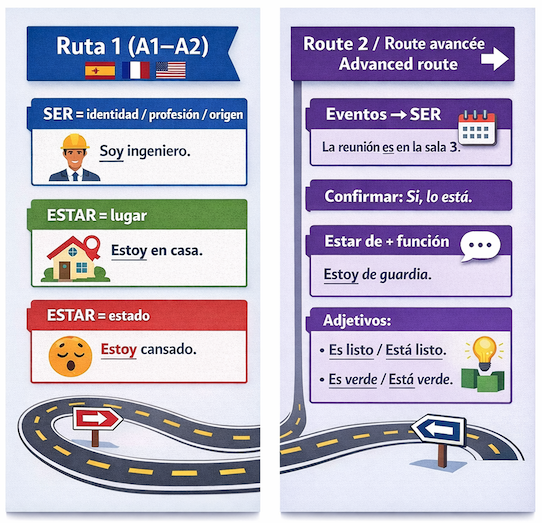
Route 1 (A1–A2): the essential core that always works
The goal here is a simple, reliable system for most everyday situations.
🪪 SER = identity, profession, origin (what/who is it?)
Use ser to say who or what someone is: identity, job, nationality, type of thing.
Examples:
– Soy Ana ( Je m’appelle Ana ).
– Es estudiante ( Elle est étudiante ).
– Somos franceses ( Nous sommes français ).
– Es un restaurante italiano ( C’est un restaurant italien ).
Si tu réponds à “qu’est‑ce que c’est ? / qui c’est ?” → pense à ser.
📍ESTAR = = lieu (où c’est ?)
Use estar to locate people, objects and physical places.
Examples:
– Estoy en clase (I am in class).
– La mesa está en el centro (The table is in the middle).
– El jefe no está en su despacho (The manager is not in his office).
If you are answering “where is it?” → think estar.
🤒 ESTAR = state (how is it now?)
Use estar for physical/emotional states or current conditions.
Examples:
– Estoy cansado (I’m tired).
– Está contenta (She is pleased).
– Estamos nerviosos (We are nervous).
– El café está frío (The coffee is cold).
📅 SER = time and date
Use ser to talk about days, dates and clock time.
Examples:
– Hoy es lunes (Today is Monday).
– Es 18 de febrero (Today is 18 February).
– Son las seis (It is six o’clock).

⚠️ Typical A1–A2 errors (and the fix)
Very common among French speakers:
– ❌ La mesa es en el centro → ✅ La mesa está en el centro.
– ❌ Estoy profesor → ✅ Soy profesor.
– ❌ Soy enfermo → ✅ Estoy enfermo.
– ❌ Cuando soy niño… → ✅ Cuando era niño… (aquí el problema ya es de tiempo, pero muestra la misma confusión).
Route 2 (B2–C1): the nuances that make you sound advanced
At B2–C1, the goal is not just “choosing the right verb” in isolated sentences, but using ser and estar to be precise: describing a photo for the DELE oral exam, sounding professional at work, avoiding ambiguity. Research on French-speaking learners shows that at B2 most errors concentrate around four areas: events, “lo está”, “estar de”, and adjectives whose meaning changes with ser/estar.
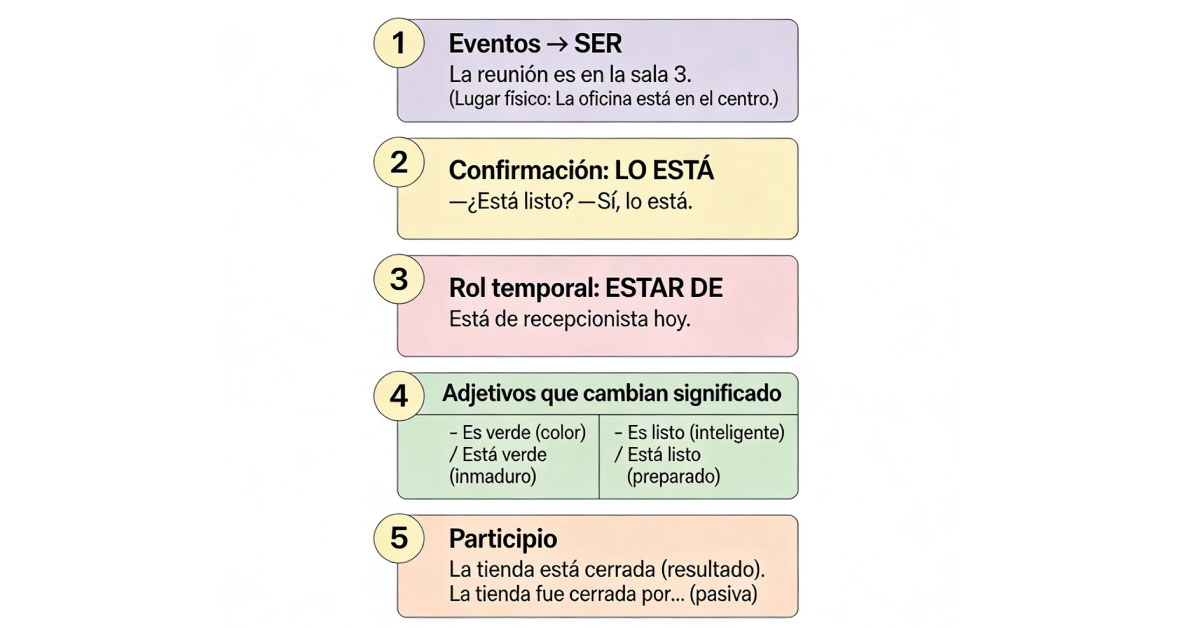
🗺️ Physical place vs event: “¿Dónde está…?” / “¿Dónde es…?”
RAE grammar puts it this way: estar is the normal verb to locate something in space (¿Dónde estás?), but when we locate actions or events in space or time, we use ser: La reunión es aquí.
Two different questions:
– ¿Dónde está el restaurante?Where is the restaurant? (place).
– ¿Dónde es la reunión? Where is the meeting taking place? (event, something that “takes place”).
Useful examples :
– La oficina está en el centro / The office is located in the city centre. (building).
– La reunión es en la sala 3 / The meeting is taking place in Room 3. (meeting).
– La conferencia es en el auditorio /The conference is taking place in the auditorium.
– El examen es el viernes y es en esta clase /The examination will take place on Friday in this classroom.
In photo descriptions, this allows you to differentiate between:
– The company is located in the city centre (if you are referring to the building).
– The interview takes place in this office (if you are referring to the event you are imagining).
😉 Confirming without repeating: “Sí, lo está”
Another advanced difficulty is using lo with estar: many learners understand it but rarely use it spontaneously.
Pattern:
– Question : ¿Está + adjetivo?
– Natural answer: Sí, lo está.
Examples:
—¿Está listo el informe? —Sí, lo está / Is the report ready? —Yes, it is ready.
—¿Está abierto el restaurante? —Sí, lo está / Is the restaurant open? —Yes, it is open.
—¿Está disponible la sala? —No, no lo está / Is the room available? —No, it is not.
This is extremely useful in professional contexts: it sounds concise and natural.
🧑💼 Stable profession vs temporary role: “ser” vs “estar de”
Learners often over-extend “profession = ser” and avoid estar for temporary roles.
– Professional identity (ser):
Es médico. / Soy ingeniera –He is a doctor. / I am an engineer.
– Temporary role (estar de):
Está de camarero este verano –He is working as a waiter this summer.
Hoy estoy de guardia – I am on call today.
Está de recepcionista mientras la compañera está de vacaciones –She is working as a receptionist while her colleague is on holiday.
In a DELE photo, this helps you speak cautiously:
– Parece que está de camarero en un bar de verano, instead of Es camarero if you don’t really know.
🔀 Adjectives whose meaning changes: lexical pairs
Some adjectives change their meaning depending on whether they go with ser or estar. These are best learned as vocabulary pairs, not as a single rule.
1. Listo
– Es listo = intelligent
– Está listo = ready.
2. Verde
– Es verde = colour.
– Está verde = unripe / not ready / inexperienced.
3. Cerrado
– Estamos cerrados / La tienda está cerrada = the shop is closed (state, now)
– Es cerrado (d’esprit, de caractère) = he/she is closed, not open-minded.
Advanced grammars stress that with ser we state a property perceived as “normal” or inherent; with estar we describe a state seen as a deviation from that normal situation.
Tip:
– If you are talking about the situation ‘in general’, you will probably use ser.
– If you are talking about the situation ‘today/now’, you will probably use estar.
More examples
| Adjective | SER (permanent) | ESTAR (temporary) |
|---|---|---|
| listo | smart: He’s listo for business. | ready: The coffee is listo. |
| bueno | good quality: He’s a good professional. | tasty: The soup is buena. |
| rico | wealthy: It’s a rica family. | tasty: This wine is rico. |
| abierto | open-minded: He’s very abierto. | open: The shop is abierto. |
| joven | young: He’s too joven to marry. | youthful: At 70 he looks joven. |
| despierto | alert: My son is despierto. | awake: Are you despierto so late? |
| fresco | cheeky: Don’t be fresco. | cool: The water is fresca. |
| rojo | red: The tomato is rojo. | blushing: He’s rojo like a tomato. |
🔥 Participles: state (estar) vs passive (ser)
Finally, you need to distinguish estar + past participle (state/result) from ser + past participle (passive).
– Estar + participle = result / current state:
La puerta está cerrada – The door is closed (you can see the closed door).
El documento está firmado –The document is signed.
– Ser + participle = passive (action, agent):
La puerta fue cerrada por el guardia(The door was closed by the caretaker).
El contrato será firmado por el director(The contract will be signed by the director).
In DELE picture descriptions you almost always want the state: las tiendas están cerradas / están llenas.
Ready-made phrases
For DELE (describing / interpreting a picture, giving your opinion)
At B1–B2, describing an image and commenting on the situation is a central task.
– Presenting: En la imagen hay… / Veo a… / Parece que están en…
– Locating: En primer plano… / Al fondo están… / A la derecha hay…
– Events: Creo que la reunión es en la oficina de la empresa.
– States/emotions: Ella está nerviosa / está concentrada.
– Interpreting: Probablemente están preparando una presentación, porque…
– Opinion: En mi opinión, es una situación bastante estresante.
For professional Spanish (meetings, emails, customer service)
– Agenda / events:
La reunión es el lunes y es en la sala 4 / The meeting will take place on Monday in Room 4.
La entrevista es a las 10 / The interview is at 10 o’clock.
– Status of documents / systems:
El informe está listo / The report is ready.
El sistema está caído / The system is down.
El pedido está enviado / The order has been sent.
– Customer service:
La tienda está abierta de 9 a 18 / The shop is open from 9 a.m. to 6 p.m.
Ahora estamos cerrados, abrimos de nuevo a las 14 / We are currently closed, but will reopen at 2 p.m.
—¿Está disponible el producto? —Ahora no lo está, pero llegará mañana / — Is the product available? — It is not available at the moment, but it will arrive tomorrow.
– Temporary roles:
Hoy estoy de guardia en recepción / Today, I am on duty at reception.
Está de sustituto esta semana / He’s the substitute this week.
How to study this without getting stuck
Based on research conducted among French speakers, here is a strategy that works well:
1. Do not learn 20 rules, but 2 or 3 key ideas per level.
2. At an advanced level, work by areas of conflict, not by endless lists:
– Place vs event (it is in / it is at).
– Lo está and estar de.
– 6 to 8 pairs of adjectives + ser/estar in actual usage (ready, green, closed, good, safe, etc.).
3. Reuse set phrases aloud (A1-B1), then combine them in real contexts (B2-C1: mini-stories, office simulations, DELE-type tasks).
No Comments