


05 Jan The Three Wise Men: an adventure spanning millennia
A story of travel, cultural magic and tradition that continues to shine on 6 January.
Have you ever wondered where the special magic of 6 January comes from in the Spanish-speaking world? Why do so many children find gifts under their pillows or next to their shoes? Today, we’ll tell you the fascinating story of the Three Wise Men, an adventure that began over 2,000 years ago and continues in dozens of countries, evolving and transforming with each generation.
The beginning: a star in the sky
Imagine the Middle East two millennia ago. Three wise men (or “magi”, as they were called in ancient times) observe the night sky from their distant lands, probably Persia or Arabia. Suddenly, they see something extraordinary: a new star shining with unusual intensity. For them, as astrologers and priests versed in celestial movements, this is a special sign.
Following the star, they embark on an epic journey of several hundred kilometres with camels laden with precious gifts. Only the Gospel according to Matthew mentions this visit in ancient texts, recounting how these travellers arrived in Bethlehem. However, the original biblical text does not specify their exact number, their names, or even that they were kings. It simply says ‘magi’, which was the term used at the time to refer to the wise men and astronomers of Persia.
Three magi… or three kings? The birth of a legend
Here is something surprising: the Bible does not mention that there were three of them, nor that they were kings.
The transformation of these characters is a fine illustration of how stories evolve over the centuries. It was Origen, a thinker from the third century AD, who proposed that there were exactly three. His reasoning was elegant: since three gifts were mentioned in the story (gold, frankincense and myrrh), it was natural to think that there were three visitors.
Then, still in the 3rd century, a writer named Tertullian proposed a bold interpretation: he interpreted a verse from the Old Testament (Psalm 72) that speaks of the ‘kings of Sheba and Arabia’ bringing gifts, and applied it to the Magi. Thus, the ‘wise men from the East’ became the ‘Three Wise Men’.
In the 5th century, the Pope Leo I the Great consolidated these changes in his ‘Sermons for Epiphany,’ officially setting the number at three kings for all of Christendom. This was a natural process of narrative construction that occurred in all ancient cultures.
And their names? Melchior, Gaspard and Balthazar first appeared in the 6th century, depicted in a magnificent mosaic in the Church of Sant’Apollinare Nuovo in Ravenna, Italy. In earlier texts, their names varied considerably depending on the culture and language. It is as if the story had been enriched over the centuries, gaining increasingly precise details.
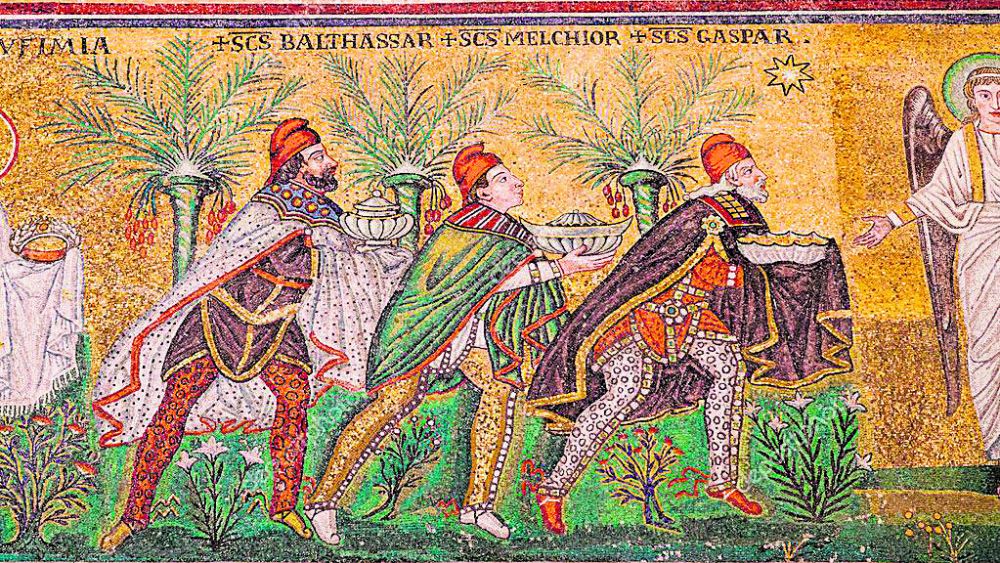
Mosaic in the Basilica of Saint Apollinaris Nuovo in Ravenna, depicting the three Wise Men. | Universal History Archive/UIG.
The three gifts: enduring symbolism
The three gifts brought by these astrologer-kings were not insignificant. Each of them had a profound meaning that still endures today:
– Gold: a symbol of wealth, power and royal status. It was the gift that powerful men gave to other powerful men.
– Incense: an aromatic substance used in rituals and sacred ceremonies throughout the Middle East. It symbolises reverence and divinity.
– Myrrh: an aromatic resin used for embalming and as a medicine. It represents mortality and sacrifice.
Each gift told a complete story. What is ingenious is that these three gifts reflect a universal truth: recognition of power, respect for the sacred, and acceptance of impermanence. Three aspects of human experience, offered to a newborn.

The Adoration of the Magi, which belongs to the collection of the Prado Museum (Madrid, Spain), is a painting by the Flemish Baroque painter Peter Paul Rubens.
Epiphany: when Christian tradition met the winter solstice
On 6 January, we celebrate what is known as Epiphany, a word that comes from the Greek “epiphaneia” and means “manifestation” or “revelation”. This feast commemorates the moment when these travellers from afar recognised and paid homage to the baby Jesus.
But here is a fascinating anecdote about cultural history: 6 January has deep pagan roots. Ancient civilisations, such as the Greeks and Egyptians, celebrated important festivals on this date, linked to the winter solstice and the rebirth of the sun. When Christianity spread throughout the world, the Church took a strategic approach: instead of suppressing existing pagan celebrations, it adapted them.
Thus, the “Light of the World” (a Christian concept) replaced the sun in the collective imagination, but the date remains the same. The festival on 6 January is a perfect example of the intertwining of cultures: pagan, Christian and folkloric elements coexist in the same celebration. The cake we eat has its roots in the Roman Saturnalia. The camels you see in the parades are echoes of biblical stories. The coal that the Befana leaves in Italy comes from ancient beliefs about winter spirits.
Spain: where tradition is a spectacle
If there is one country where 6 January is truly a national holiday, it is Spain. Here, this date is an official public holiday, and the celebration is an event that mobilises entire cities.
The afternoon of 5 January: the Three Kings’ parade
Imagine the streets of Madrid, Barcelona, Seville or any small Spanish village filled with thousands of people — children, parents, grandparents — waiting eagerly. Suddenly, music blares. Lights flash. And they appear: the Three Kings in spectacular decorated floats, pulled by horses or, in many cases, real camels.
The Cabalgata de Reyes is the most eagerly awaited parade of the year in Spain. The modern tradition began in 1866 in Alcoy (Valencia), but it has been celebrated without interruption since 1885. Today, almost all Spanish towns have their own version, some so creative that the Kings arrive by helicopter (Logroño), boat (Gijón) or even motorbike (in some more modern villages).
During the parade, the Kings and their court slowly make their way through the streets, waving and throwing thousands of sweets, chocolates and toys to the crowd. In large cities such as Seville, more than 100,000 kilos of sweets are distributed in a single afternoon. It is an act of collective generosity that has become a tradition.

The Three Kings Parade in Madrid
The morning of 6 January: the Roscón de Reyes
No celebration of the Three Kings is complete without the Roscón de Reyes, a sweet cake shaped like a crown and decorated with shiny candied fruit. Its origin is a perfect blend of traditions: it has its roots in the Roman Saturnalia (pagan celebrations where a “king of the feast” was chosen), but it was Christianised and associated with 6 January.
The roscón has two magical secrets hidden in its dough:
1. A small figurine: whoever finds it becomes the “king” or “queen” for the day and can wear an imaginary crown while their friends and family treat them like royalty.
2. A dry bean: here’s the joke: whoever finds it has the “luck” (on the mocking side) of paying for the roscón the following year.
Around the Spanish family table, as the roscón is distributed, the tension is palpable. Each piece could be the winner. The cries of joy when someone finds the figurine are a moment of pure Christmas magic. It is a tradition that combines superstition, humour and community.
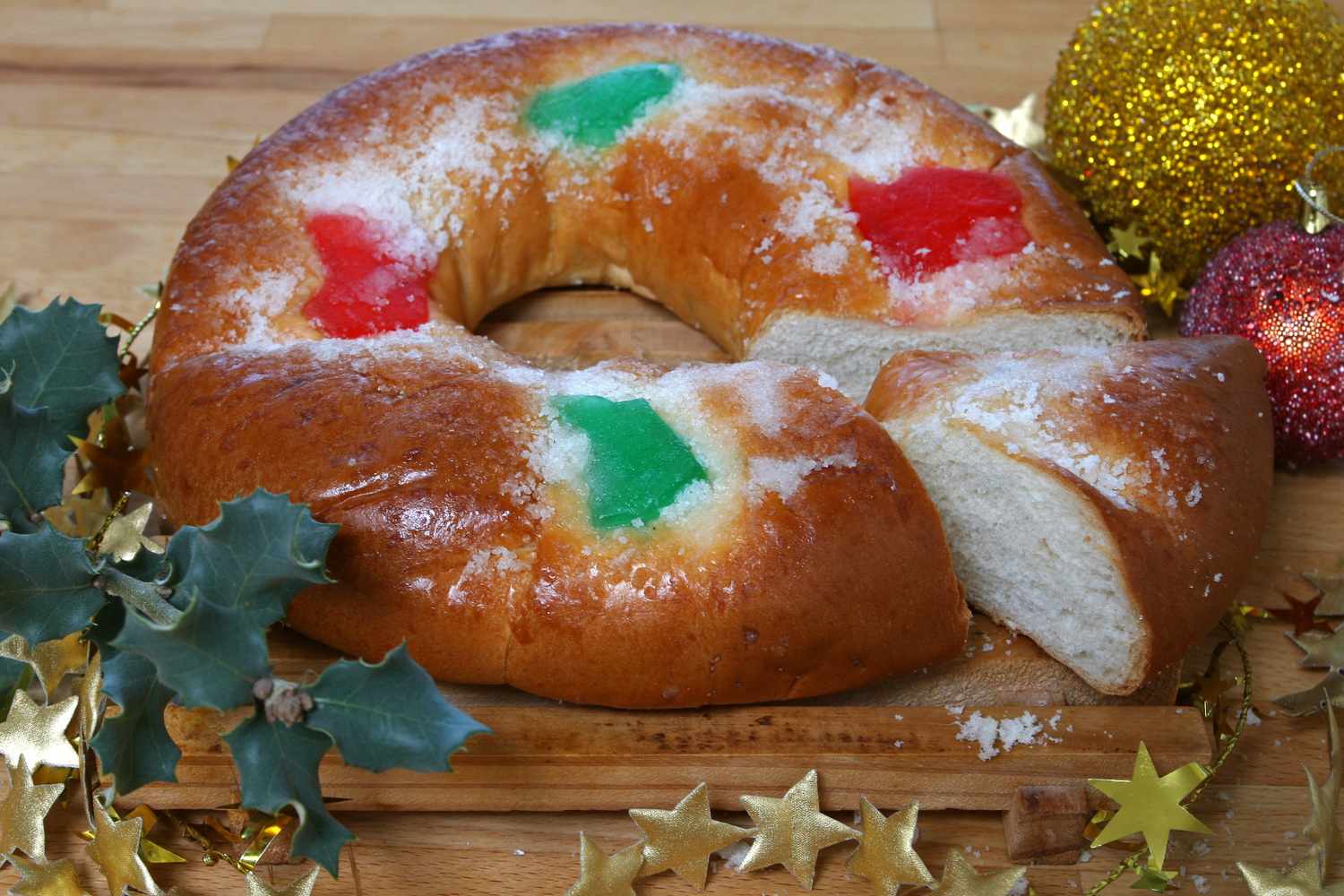
Roscón de Reyes. Source: Asimetrica Juniper/Getty Images
Across the ocean: Kings in Latin America
The Three Wise Men did not remain in Spain. They travelled aboard Spanish ships to America during the conquest and colonisation, where they adapted to new climates, cultures and realities.
Mexico: the rosca evolves
In Mexico, 6 January is the traditional day when children receive their main gifts, even more important than Christmas on 25 December. The celebration includes the Rosca de Reyes, similar to the Spanish roscón but with a Mexican twist.
Instead of a single figurine, the Mexican Rosca contains several figurines of the Baby Jesus scattered throughout the dough. Whoever finds one of these figurines has the honour and duty of organising the Candelaria (Candlemas) celebration on 2 February, thus continuing the chain of celebrations and sharing hot atole and sweet bread with friends and family.
Homes are also decorated with nativity scenes depicting the birth of Jesus in Bethlehem. These scenes evolve throughout the Christmas period, and on 6 January, the figures of the Three Wise Men are added, completing the visual narrative.
Puerto Rico: Kings travel on horseback
In Puerto Rico, the tradition is even older. It is believed that the first religious celebration in America was a Mass celebrated on 6 January.
Here, children leave shoeboxes filled with fresh grass (called ‘grama’) to feed the camels… but there is a tropical twist: the Kings travel on horseback, not camelback, because living on a tropical island makes horses the most logical and accessible choice.
The ‘Promesas de Reyes’ (promises to the Three Kings) are a tradition unique to Puerto Rico: they are commitments made by believers who ask for special favours in exchange for a promise of generous behaviour or action. It is a way of linking tradition to personal wishes.
Since 1884, the municipality of Juana Díaz has celebrated the oldest and most popular Three Kings Day festival in Hispanic America, attracting tens of thousands of people every year. This celebration combines religious tradition, folklore, music, gastronomy and community spirit.
Venezuela and other Latin American countries
Venezuela, Colombia, and other Latin American countries have traditions similar to those in Puerto Rico, with family celebrations, special meals, and the distribution of gifts on 6 January. The adaptation of the tradition to each region demonstrates the flexibility and enduring relevance of this celebration.
Europe: magical variations
Italy: La Befana, the kind witch
Italy has its own magical character who rivals the Three Wise Men: the Befana, a benevolent old witch who is at the heart of the Italian celebration on 6 January.
According to legend, the Befana was invited by the Three Wise Men to join them on their journey to Bethlehem. She helped them by giving them sweets and information, but declined their invitation to accompany them. Later, she deeply regretted this decision. She prepared a basket filled with sweets and gifts and set off in search of the Three Wise Men to find the baby Jesus. When she failed to find them, she decided to leave gifts in every house she came across on her journey, in the hope that one of the children would be the one she was looking for.
Today, according to tradition, the Befana flies on her broomstick during the night of 5 to 6 January, leaving sweets and treats for well-behaved children and coal (in the form of black sweets) for naughty children. Her origins are ancient: they stem from pagan Roman rituals in which mysterious female figures were believed to fly over the fields during the winter solstice to ensure good harvests.
France: the Galette des Rois
In France, Epiphany is celebrated with the Galette des Rois, a puff pastry filled with almonds and containing a hidden bean inside, similar to the Spanish roscón concept. It is celebrated on 6 January or the second Sunday after Christmas, and is a sweet tradition that continues in French bakeries and homes.
Portugal and other European countries
Portugal also celebrates 6 January with its own traditions, and in places such as Monção, parades and community celebrations are organised.
Why is it still special?
Over the past 2,000 years, the story of the Three Wise Men has travelled further than any ancient caravan. It has crossed oceans, adapted to new cultures, and been enriched with new names, new characters, and new culinary traditions. It has been reinterpreted, dramatised, and become more magical with each new version.
Why does it endure? Perhaps because it is about travel and the quest for the extraordinary. Perhaps because it is, above all, a story about generosity, those gifts that were not intended to receive anything in return, but simply to honour someone special. Or perhaps simply because the experience of a child discovering an unexpected gift is a magic that time cannot erase. It is pure surprise, pure joy.
This 6 January, wherever you are — in a Spanish town watching camels parade by, in a Mexican home sharing a Rosca, on a Caribbean island waiting for the Three Kings on horseback, or in Italy waiting for the Befana — remember that you are part of a tradition that has united entire cultures for millennia. It is a celebration of human diversity, of how different places take the same motif and transform it into something unique and their own.
The Three Wise Men still travel. The camels still arrive. La Befana still flies through the air. The magic lives on.
May the Three Wise Men, the Befana, or whoever watches over you on 6 January bring you whatever you desire!
No Comments