


15 Mar Por and para in Spanish: a clear guide for French speakers
If you speak French and are learning Spanish, it’s very likely you’ve already experienced this: you want to write a simple sentence, you hesitate between por and para, and you end up choosing almost at random.
That’s quite normal. In French, a single word often covers concepts that are distinct in Spanish. That’s why the difference between ‘por’ and ‘para’ is one of the most frequently asked questions among French speakers learning Spanish, whether in class, whilst preparing for the DELE, or in more professional contexts. If you’re studying Spanish at a school such as ELE USAL Strasbourg, this is one of those points you need to get right from the start.
The good news is that you don’t need to memorize twenty rules by heart. What really helps is understanding a few very clear decisions and the logic behind them.
A simple idea to start with
Picture this mental image:
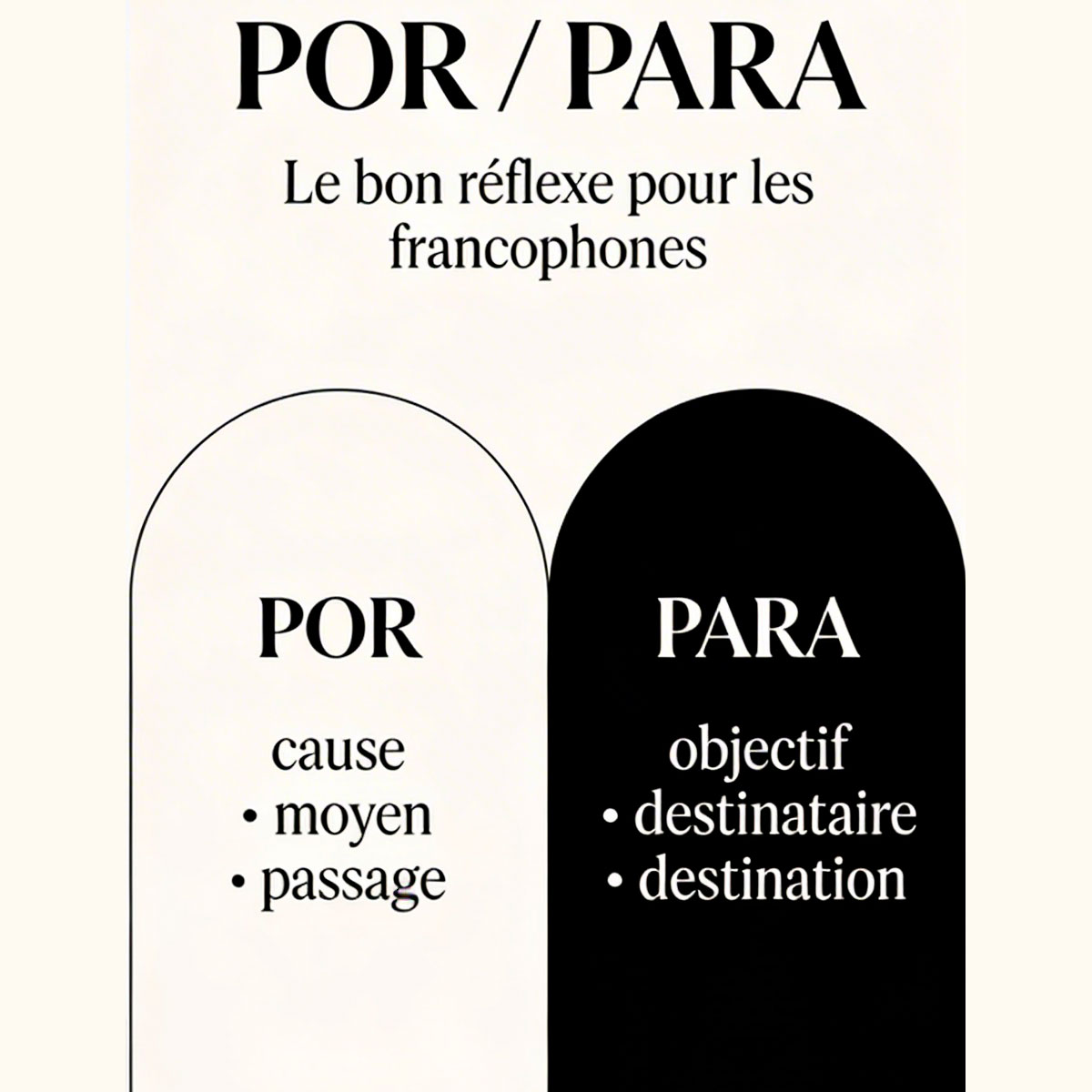
– POR looks toward the cause, the means or the path
– PARA looks toward the goal, the recipient or the destination
It’s not a magic formula that works in every situation, but it’s a very useful starting point for using ‘por’ and ‘para’ in Spanish with greater confidence.
In other words:
– POR often answers: why? how? through where?
– PARA often answers: what for? for whom? by when? towards where?
Once you grasp this logic, the topic stops feeling like a random list.
First decision: are you talking about the reason or the goal?
This is the heart of the whole topic.
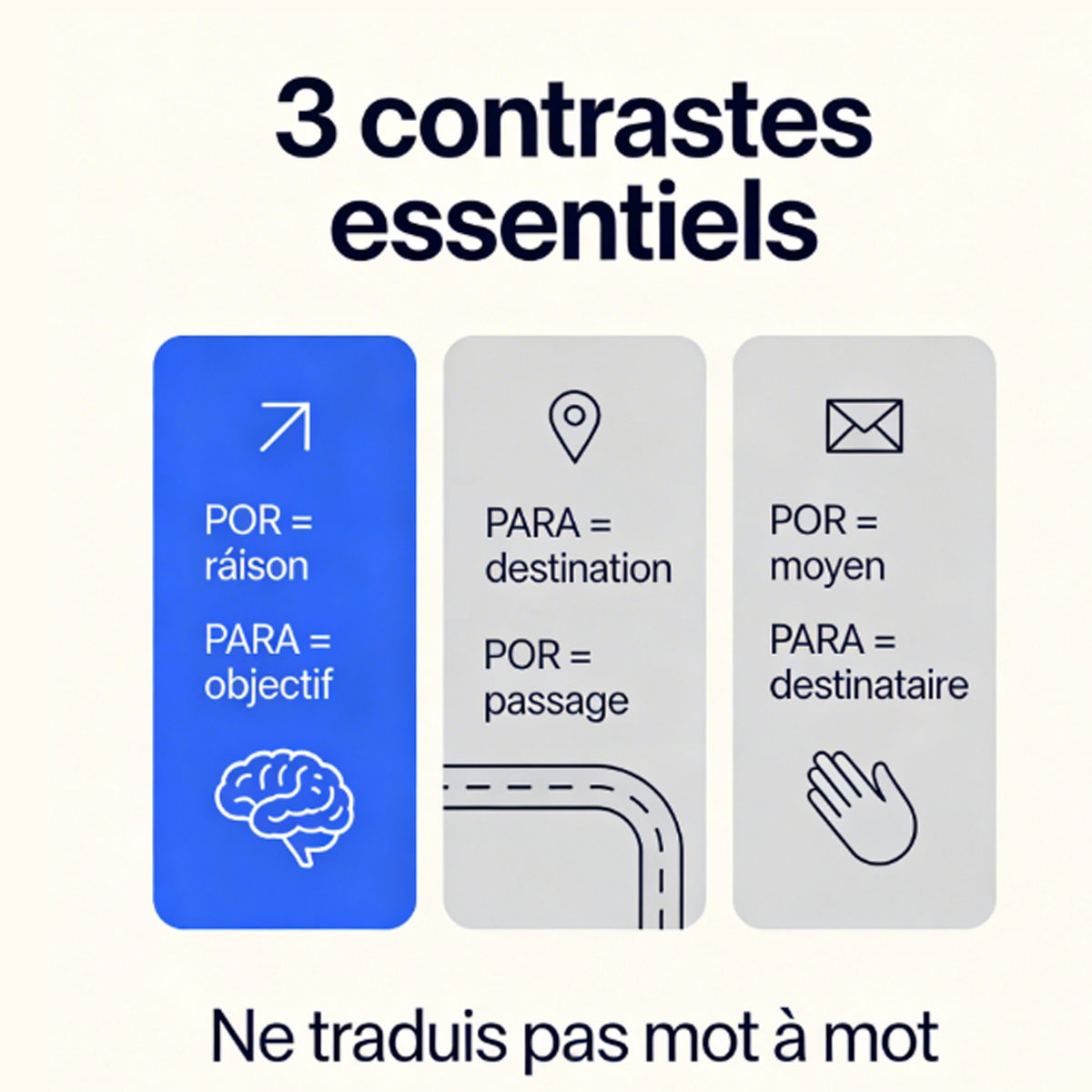
If you’re talking about the reason, use POR
– Lo hice por miedo.
– No vino por la lluvia.
– Trabajo por dinero.
Here, por indicates the cause or reason. The question would be: why?
If you’re talking about the goal, use PARA
– Lo hice para ayudarte.
– Estudio para el DELE.
– Trabajo para ganar dinero.
Here, para indicates the purpose or goal. The question would be: what for?
What really changes
Compare these two sentences:
– Trabajo por dinero.
– Trabajo para ganar dinero.
They seem similar, but they don’t mean the same thing.
– In the first, money is the reason.
– In the second, earning money is the goal.
This contrast is fundamental for any French speaker who wants to speak or write with more precision.
Second decision: are you passing through a place or going towards it?
Another very useful point is to distinguish between the journey and the destination.
If a place is part of the journey, use POR
– Pasé por tu casa.
– Paseamos por el centro.
– Voy por el parque.
Here the idea is that this place is part of the path.
If that place is the destination, use PARA
– Voy para Madrid.
– Salimos para casa.
– Este tren sale para Asturias.
Here the idea is that this place is the end of the journey.
A simple way to remember it
– POR = I pass through there
– PARA = I am going towards there
This contrast helps a lot in everyday life, but also in DELE speaking tasks or conversation classes.
Third decision: are you talking about the means or the recipient?
This block is especially useful for emails, work and professional life.
If you’re talking about the means, use POR
– Te llamo por teléfono.
– Te lo envío por correo electrónico.
– Viajamos por tren.
Here you’re saying how you do something.
If you’re talking about the person who receives something, use PARA
– Este regalo es para ti.
– Este documento es para el director.
– Lo compré para ella.
Here you’re saying to whom something is intended.
The question that helps the most
– How do I send it? → por
– For whom is it? → para
This brief comparison is very useful in a professional context when using Spanish, for example if you’re taking a course funded by the CPF, writing emails or practising your written Spanish.
Por ti and para ti: a small difference, a huge change
There are pairs of expressions that look almost identical, but are completely different. One of the most important is this one:
– Lo hice por ti.
– Lo hice para ti.
Lo hice por ti
This means that you are the cause, the reason or the motive.
Lo hice para ti
This means that you are the recipient or the beneficiary.
In other words
– por ti = because of you
– para ti = intended for you
This contrast comes up very often in everyday conversation and is extremely useful for fully understanding the general logic behind ‘por’ and ‘para’.
Para mí and por mí: another classic
This is another very common mistake for French speakers.
Para mí
This means:
– in my opinion
– from my point of view
Example:
– Para mí, esta opción es mejor.
Por mí
This means:
– if it depends on me
– I don’t object
– no problem from my side
Example :
– Por mí, podemos empezar ya.
The important thing
These are not two equivalent versions. They change the meaning completely.
– para mí = opinion
– por mí = permission or no objection
A natural use of para
There’s a use of para that can seem strange at first, but actually expresses a very simple idea.
Look at these examples:
– Para ser principiante, hablas muy bien.
– Para ser junio, hace frío.
– Para su edad, corre muy rápido.
What these sentences really want to say is something like
– if we take into account that…
– although…
– what’s surprising is that…
Clear example
– Para ser principiante, hablas muy bien.
The idea is:
if we take into account that you are a beginner, it’s surprising that you speak so well.
This usage is useful because it makes your Spanish sound more natural and more nuanced, especially in descriptions or opinions.
The most frequent mistakes of French speakers
No need for a huge list. It’s better to focus on the mistakes that really help fix the system.
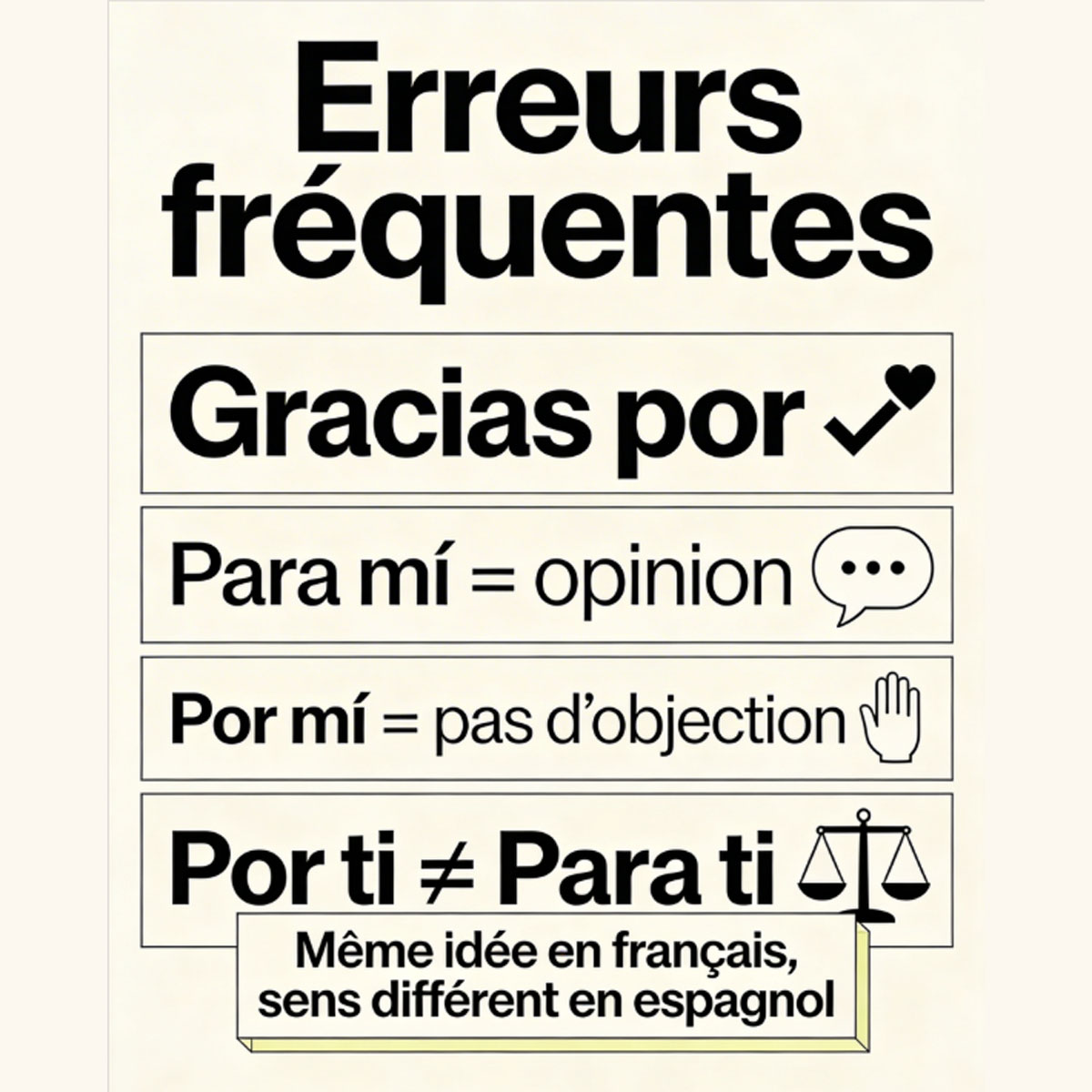
Mistake 1 : Gracias para tu mensaje
The correct form is:
– Gracias por tu mensaje.
Why? Because the message is the reason for the thanks, not its goal.
Mistake 2 : Por mí, esta idea es buena
If you want to give an opinion, you need to say:
– Para mí, esta idea es buena.
Mistake 3 : Paso para Madrid
If Madrid is a place of passage:
– Paso por Madrid.
If Madrid is your destination:
– Voy para Madrid.
Mistake 4 : thinking that por ti and para ti mean the same thing
They mean nothing alike.
– por toi = you are the cause
– pour toi = you are the recipient
Mistakes like these are very common when learning Spanish from French, which is why it’s worth practising them using clear, repeated examples.
What to ask yourself when you’re unsure
If you’re writing a sentence and you’re not sure what to choose, don’t start by thinking about complicated rules. Stop for a second and ask yourself:
– Am I giving the reason? → por
– Am I expressing a goal? → para
– Am I talking about the means?→ por
– Am I talking about the recipient? → para
– Is it a place of passage? → por
– Is it the destination?→ para
– Am I giving my opinion?→ para mí
– Am I saying I don’t object?→ por mí
This kind of questioning helps much more than trying to memorise an abstract list of rules.
A small table to sum it up
| If you want to express… | Use | Example |
|---|---|---|
| The reason | por | Lo hice por miedo |
| The goal | para | Estudio para el DELE |
| The means | por | Te llamo por teléfono |
| The recipient | para | Este regalo es para ti |
| A place of passage | por | Pasé por tu casa |
| A destination | para | Voy para Madrid |
| An opinion | para | Para mí, es una buena idea |
| No objection | por | Por mí, podemos empezar |
Ready-to-use phrases
For work
– Gracias por tu correo.
– Te envío el documento por email.
– Este informe es para dirección.
– ¿Podrías tenerlo listo para el viernes?
For the DELE or class
– Para mí, aprender por y para es fundamental.
– Muchos estudiantes cometen errores por traducir desde su lengua materna.
– Estudio español para trabajar mejor y para preparar el examen.
Practising in context
Understanding the difference between por and para in Spanish becomes much easier when you practise in context, with correction and examples adapted to your level. That’s why, in a school like ELE USAL Strasbourg, this kind of content doesn’t just serve to read grammar: it also helps prepare lessons, improve written expression and gain confidence when speaking.
If you’re preparing for the DELE, if you’re looking for a CPF training or if you simply want to improve your Spanish in Strasbourg, working on these differences with real examples can really make a difference.
Final mini-test
Complete with por or para:
1. Gracias ___ tu ayuda.
2. Lo necesito ___ mañana.
3. Pasamos ___ el centro antes de volver.
4. Este regalo es ___ Ana.
5. ___ mí, esta solución es mejor.
6. ___ mí, podemos empezar ya.
Solutions
– por
– para
– por
– para
– Para
– Por
No Comments