


16 Oct Gustar in Spanish: why do we say “me gusta”?
You know how to say “I like cinema” in English, or “j’aime le cinéma” in French. Then you meet me gusta el cine in Spanish, followed by me gustan las películas. Why does the verb change when you are still talking about yourself?
The answer lies in the sentence structure. To understand gustar in Spanish, think “to be pleasing to” rather than simply replacing “to like”. For French speakers, plaire provides a particularly useful comparison: le cinéma me plaît, les films me plaisent. In the usual Spanish construction, the thing that is pleasing is the grammatical subject; the person who likes it is expressed through an indirect object. The RAE–ASALE dictionary of usage explains this distinction.
The essentials in 30 seconds
- Think “it is pleasing to me” to understand the structure.
- Me tells you who likes it; the thing liked is the subject.
- Me gusta el cine: a singular subject.
- Me gustan las películas: a plural subject.
- Me gusta leer: an activity expressed by an infinitive.
- A mí también and a mí tampoco help you respond.
In this article
The structure · Gusta or gustan · The pronouns · A mí me gusta · Responding · Common mistakes · Exercises · FAQ
Understanding gustar in Spanish: think “to be pleasing”
The thing you like is the subject
| Natural English | To understand the structure | Spanish |
|---|---|---|
| I like cinema. | Cinema is pleasing to me. | Me gusta el cine. |
| I like films. | Films are pleasing to me. | Me gustan las películas. |
| I like reading. | Reading is pleasing to me. | Me gusta leer. |
The middle column is a grammatical stepping stone, not a model for natural translation. In conversation, “I like cinema” remains a natural way to translate me gusta el cine.
In me gustan las películas, the grammatical subject is las películas, not the person who likes them. That is why the verb is plural.
The pronoun identifies the person
One sentence, three parts
- Me: who finds it pleasing — me.
- Gusta: the verb.
- El cine: the subject — the thing liked.
Ask two separate questions: who likes it? What is liked? The first helps you choose the pronoun. The second helps you choose the verb form.
Me gusta or me gustan: which should you use?
When talking about objects, interests and activities in the present, you will very often use gusta and gustan. They are two common forms, not the only forms of the verb.
A singular noun: gusta
- Me gusta este libro. — I like this book.
- Te gusta la música. — You like music.
- Nos gusta el español. — We like Spanish.
The subjects — este libro, la música and el español — are singular, so the verb is singular.
A plural noun: gustan
- Me gustan estos libros. — I like these books.
- Le gustan las canciones. — He or she likes the songs.
- Nos gustan los idiomas. — We like languages.
Here, the subjects are plural, so the verb is plural too. The change does not depend on how many people like something.
An activity in the infinitive: gusta
- Me gusta leer. — I like reading.
- Nos gusta viajar. — We like travelling.
- Les gusta aprender español. — They like learning Spanish.
With a single activity expressed by an infinitive, use gusta here. The Instituto Cervantes curriculum introduces this construction at A1.
| What is liked | Form | Example |
|---|---|---|
| A singular noun | gusta | Me gusta el cine. |
| A plural noun | gustan | Me gustan las películas. |
| An activity expressed by an infinitive | gusta | Me gusta bailar. |
A teacher’s tip
Start with one subject or one activity per sentence. Coordinated lists sometimes need further explanation: choosing the verb form is not simply a matter of counting the words after it.
Me, te, le, nos, os, les: who likes it?
These indirect object pronouns identify the person experiencing the liking or interest.
| Person concerned | Pronoun | Example |
|---|---|---|
| Me | me | Me gusta el café. |
| You: tú | te | Te gusta el café. |
| Him, her, or formal singular you: usted | le | Le gusta el café. |
| Us | nos | Nos gusta el café. |
| You: vosotros/vosotras | os | Os gusta el café. |
| Them, or plural you: ustedes | les | Les gusta el café. |
Notice that gusta stays the same throughout: the subject is always el café.
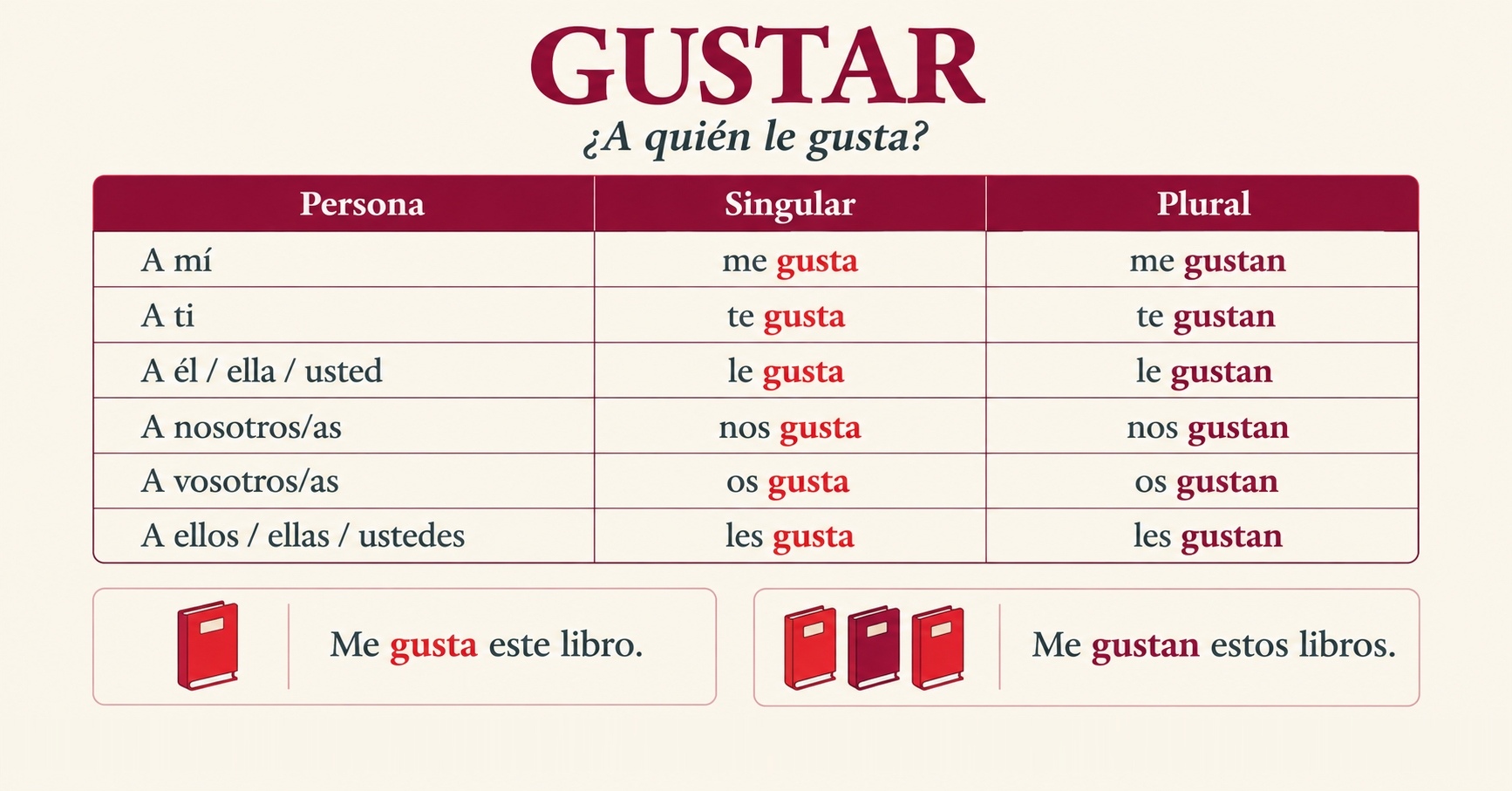
Common present-tense forms for expressing likes. The text table above explains the same structure in English.
Why is it nos gusta?
- Me gusta el museo. — I like the museum.
- Nos gusta el museo. — We like the museum.
- Nos gustan los museos. — We like museums.
Changing me to nos changes the person concerned, not the subject. The verb becomes plural when the subject becomes los museos.
Plural “you”: os or les?
With vosotros, ask ¿Os gusta esta canción?. With ustedes, ask ¿Les gusta esta canción?.
Ustedes is the general plural form of address in Spanish-speaking America and is also used in some varieties of Spanish in Spain. Vosotros is common in much of Spain for informal plural address. In both examples, the singular subject is esta canción.
Why do we say a mí me gusta?
Me gusta el café is already a complete sentence. You can also say A mí me gusta el café. A mí can add emphasis or introduce a contrast, but it does not replace me.
Adding emphasis or contrasting tastes
Comparing preferences
A mí me gusta el café, pero a ti te gusta el té.
I like coffee, whereas you like tea.
A mí and a ti make the contrast explicit. Both Me gusta el café and A mí me gusta el café are valid. Do not write A mí gusta el café for this construction.
Making le and les clearer
Le gusta leer does not tell you by itself whether the person is “he”, “she” or someone addressed as usted. You can clarify:
- A Clara le gusta leer.
- A él le gusta leer.
- A usted le gusta leer.
The phrase introduced by a identifies the person; le keeps its role in the sentence.
Negatives, questions and short responses

The same drink, different preferences: me gusta and no me gusta.
No me gusta and ¿te gusta?
To express a negative preference in these simple sentences, put no before the pronoun:
- No me gusta el café. — I don’t like coffee.
- No me gustan las películas de terror. — I don’t like horror films.
To ask a question:
- ¿Te gusta leer? — Do you like reading?
- ¿Te gustan estas canciones? — Do you like these songs?
Making the sentence negative or turning it into a question does not change agreement with the subject.
A mí también or a mí tampoco?
Both English “me too” and French moi aussi can tempt learners to use yo también every time. To respond by echoing a me gusta construction, use a mí también. For agreement with a negative statement, use a mí tampoco.
| The other person says… | Your preference | Your response |
|---|---|---|
| Me gusta leer. | You like reading too. | A mí también. |
| No me gusta madrugar. | You don’t like getting up early either. | A mí tampoco. |
| Me gusta el café. | You don’t like it. | A mí no. |
| No me gusta el café. | You do like it. | A mí sí. |
Compare Estudio español. — Yo también. with Me gusta el español. — A mí también.. The response follows the grammatical role of the person. This guide to short responses explains the distinction.
Common mistakes to avoid
Agreement, determiners and mucho
| Incorrect for the intended meaning | Correction | Why? |
|---|---|---|
| Me gusta los libros. | Me gustan los libros. | Los libros is plural. |
| Nos gustan el cine. | Nos gusta el cine. | El cine is singular. |
| A mí gusta leer. | A mí me gusta leer. | A mí does not replace me. |
| Me gusta paella. | Me gusta la paella. | For this general preference, the noun needs a determiner here. |
| Me gusta muy. | Me gusta mucho. | Use mucho to intensify the verb here. |
Do not conclude that every noun must have el or la. Other determiners work too: Me gusta este libro and Me gustan tus ideas.
This is particularly worth noticing for English speakers: English often omits the article in “I like music”, while Spanish uses Me gusta la música. French J’aime la musique offers a helpful comparison.
The Instituto Cervantes curriculum also distinguishes mucho after a verb from muy before an adjective or adverb. See the RAE–ASALE definition of muy.
Gustar has more than two forms
Me gustas. — I like you / I am attracted to you, depending on the context. The subject is tú, so the verb is second-person singular: gustas. Conversely, Te gusto means “You like me”.
Me gustas can express attraction in a personal context. It is not automatically equivalent to a strong romantic “I love you”.
Agreement is not determined by word order
Estos libros me gustan.
The subject is still estos libros, even though it comes before the verb. The rule concerns the grammatical subject, not where words happen to appear.
Encantar and interesar: reuse the pattern
| Spanish | English |
|---|---|
| Me encanta esta canción. | I love this song. |
| Me encantan estas canciones. | I love these songs. |
| Me interesa la historia. | History interests me. |
| Me interesan los idiomas. | Languages interest me. |
In these uses, the person concerned is expressed through an indirect object, while the verb agrees with what produces the feeling or interest. The Instituto Cervantes curriculum includes encantar and interesar alongside this pattern.
On the ELE USAL Strasbourg blog, the aim is to give you patterns you can reuse: understanding how the words relate to one another helps you build new sentences rather than memorise just one expression.
Gustar exercises with answers
These exercises were written for this article using the rules explained above. Try each set before reading its answers.
1. Complete with gusta or gustan
- Me ______ esta canción.
- Nos ______ los libros.
- ¿Te ______ viajar?
- A Clara le ______ las películas mexicanas.
- Les ______ aprender español.
Answers · Exercise 1
- 1. Gusta: esta canción is singular.
- 2. Gustan: los libros is plural.
- 3. Gusta: viajar is an infinitive.
- 4. Gustan: las películas mexicanas is plural.
- 5. Gusta: aprender español expresses an activity.
2. Correct the sentences
- A mí gusta el cine.
- Nos gustan la música.
- Me gusta los museos.
- Me gusta muy leer.
Answers · Exercise 2
- A mí me gusta el cine.
- Nos gusta la música.
- Me gustan los museos.
- Me gusta mucho leer.
3. Respond according to your preferences
- Me gusta leer. You share this preference.
- No me gusta madrugar. You also dislike this.
- Me gusta el café. You don’t like it.
- No me gusta el café. You do like it.
Answers · Exercise 3
- A mí también.
- A mí tampoco.
- A mí no.
- A mí sí.
Your turn · A1–A2
Write three personal sentences: one with a singular noun, one with a plural noun and one with an infinitive. Check the pronoun and the verb agreement separately.
Frequently asked questions
Why do we say me gusta rather than yo gusto?
To express “I like it”, Spanish usually uses a structure comparable to “it is pleasing to me”. Me identifies the person concerned; the thing liked is the subject. Yo gusto exists, but it does not simply mean “I like” in this construction.
What is the difference between gusta and gustan?
In the present tense, gusta is used with a third-person singular subject, such as el cine, and gustan with a plural subject, such as las películas.
Why is it nos gusta?
Because nos means “to us” and is not the subject. In Nos gusta el cine, the singular subject is el cine.
Do I always need a mí me gusta?
No. Me gusta is enough. A mí can add emphasis or contrast your preference with someone else’s. If you add it, keep me.
How do I say “I like reading”?
Me gusta leer. The infinitive expresses the activity you enjoy and takes gusta here.
What does me gustas mean?
“I like you”, potentially expressing attraction depending on the context. The subject is tú, which explains the form gustas.
Why respond with a mí también?
It follows the role of the person in me gusta. Yo también works, for example, in response to Estudio español, where the person is the subject.
Sources and further reading
- RAE–ASALE · Gustar: sentence structure and grammatical subject (Spanish).
- Instituto Cervantes · A1–A2 grammar: pronouns, infinitives and gustar constructions (Spanish).
- RAE–ASALE · Muy: uses of the adverb (Spanish).
- Kwiziq · Yo también and a mí también: short responses (English).
- Burbuja del Español · Short responses: agreement and disagreement (Spanish).
The examples and exercises in this article are teaching materials, not quotations attributed to named authors.
No Comments