


20 Oct Why was the 1918 pandemic called Spanish Flu?
A worldwide pandemic, a neutral Spain and a freer press: discover why one of the deadliest outbreaks in history bears a name that does not necessarily reflect where it began.
During a Spanish class at university, we asked students which words or images they spontaneously associated with Spain. Among the answers, one student suggested a rather unexpected expression: “Spanish flu”.
This comment gave us an opportunity to revisit a fascinating episode in modern history. Contrary to what its name suggests, there is no evidence that the pandemic originated in Spain.
So why did this disease, which swept across the world from 1918 onwards, become known as “Spanish flu”? To understand the name, we need to return to the First World War, when the circulation of information was closely bound up with political and military interests.
A pandemic that changed the world
In 1918, as the First World War was drawing to a close, an exceptionally virulent influenza epidemic spread across several continents.
Unlike ordinary seasonal flu outbreaks, which mainly threaten older and more vulnerable people, this new strain also caused unusually high mortality among young adults, particularly those aged between 20 and 40.
Wartime conditions helped it spread: soldiers lived in overcrowded camps, military movements multiplied and civilian populations suffered severe shortages.
The disease rapidly spread around the globe, affecting Europe, the Americas, Asia, Africa and Oceania.
The pandemic, caused by an influenza A(H1N1) virus, came in several waves during 1918 and 1919, with outbreaks continuing in some places into 1920. The autumn 1918 wave was particularly deadly.

Emergency hospital, Camp Funston, Kansas, 1918. Otis Historical Archives, National Museum of Health and Medicine, NCP 1603.
But why has Spain remained associated with this worldwide public-health catastrophe?
The First World War and the silence of the press
To understand where the name came from, we must place ourselves in the world of 1918.
The First World War pitted several major European powers against one another. In France, the United Kingdom, Germany and other countries involved in the conflict, the authorities closely monitored the information published in newspapers.
One of their aims was to preserve morale among both civilians and troops.
In this context, news about the epidemic could be restricted, downplayed or delayed. Newspapers also practised a degree of self-censorship to avoid suggesting that their country had been weakened.
The Spanish press was therefore not subject to the same military censorship restrictions as newspapers in the belligerent countries.
When the epidemic spread through Spain in the spring of 1918, newspapers reported on it openly.
They published information about the number of people falling ill, the impact on daily life and prominent figures who had contracted the disease.
This difference in media coverage would play a decisive role in the name given to the illness.
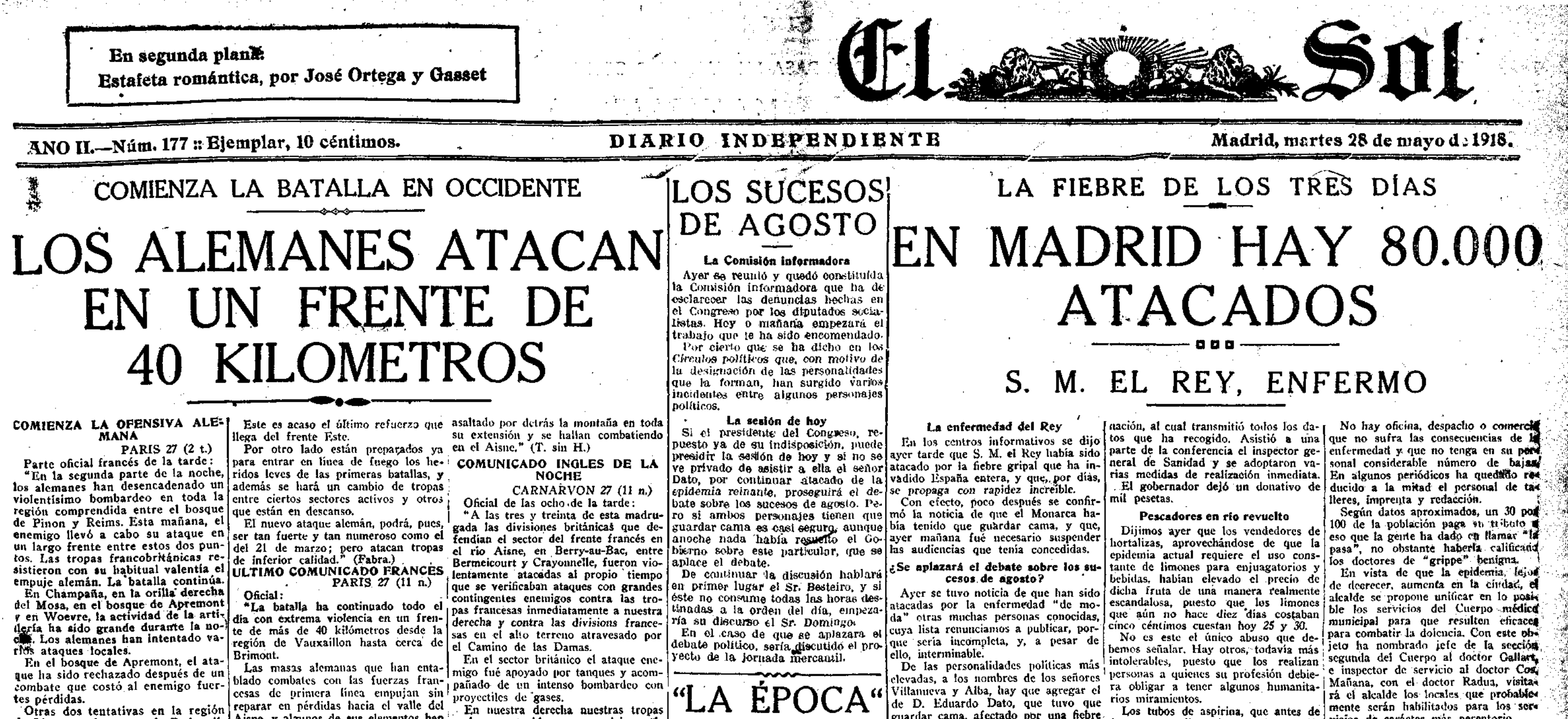
“In Madrid, 80.000 people are affected”. Front page of the newspaper El Sol, 28 May 1928. Source: National Library og Spain, digital newspaper archive
Why was it called Spanish flu?
In the spring of 1918, Spanish newspapers devoted considerable attention to the epidemic. In Madrid, the daily newspaper El Sol was reporting on it by 22 May.
The illness affected many people, including King Alfonso XIII, whose health attracted the attention of the international press.
Newspapers abroad repeated reports coming out of Spain. The disease consequently appeared to be particularly widespread there, simply because its effects were being reported more openly.
Gradually, the expression Spanish flu in English, or grippe espagnole in French, began to circulate.
On 3 June 1918, a correspondent for the British newspaper The Times used the term in a report from Spain, helping it spread.
Spain was neither the only country affected nor necessarily the first. It was simply one of the places where the epidemic was most visible in the media.
It would, however, be misleading to claim that all newspapers in countries at war remained silent. In France, for example, the press also covered the epidemic, but its reporting was shaped by the military context, censorship and self-censorship.
King Alfonso XIII also played a role in another remarkable episode of First World War history. Discover how the Spanish monarch helped prisoners of war and missing civilians in our article:
Alfonso XIII, the laundress and the 200,000 prisoners.
In Spain, it was called “el soldado de Nápoles”
Interestingly, Spaniards themselves did not initially refer to the disease as “Spanish flu”.
One of the expressions used in Spain was el soldado de Nápoles, meaning “the soldier from Naples”.
This curious nickname came from the world of music and theatre, particularly the popular zarzuela La canción del olvido, composed by José Serrano.
The melody associated with the soldier from Naples was extremely catchy and had become widely known. The epidemic was compared to this tune because it spread just as quickly and seemed impossible to escape.
This linguistic detail illustrates how different societies can interpret and name the same historical event in very different ways.
Where did the 1918 influenza pandemic really begin?
Despite more than a century of research, the exact geographical origin of the 1918 influenza pandemic remains uncertain.
Historians, epidemiologists and virologists have proposed several hypotheses, but none has been conclusively demonstrated.
The American hypothesis
One of the most frequently discussed hypotheses points to the United States, where outbreaks were documented among military personnel in early 1918.
Camp Funston, in Kansas, is often mentioned because of the large number of cases recorded there.
However, the existence of early documented outbreaks does not prove that the virus originated in that location.
The European hypothesis
Other researchers have examined respiratory disease outbreaks observed in Europe before 1918, particularly in military environments.
Some have suggested that an earlier form of the virus may already have been circulating, although the available evidence does not establish a definitive origin.
Other hypotheses
Other possible geographical origins have also been considered, including parts of Asia.
The difficulty lies in the limited medical records available from the period, the lack of systematic international surveillance and the fact that the virus could have circulated before the first major outbreaks were documented.
Why is the name “Spanish flu” still used today?
More than a century after the pandemic, the expression “Spanish flu” remains widely used in English, French, Spanish and many other languages.
Yet it rests on a misleading geographical association.
This story shows how a name can become firmly established in everyday usage even when it does not reflect a scientifically demonstrated fact.
Today, public-health specialists pay particular attention to this issue.
In 2015, the World Health Organization (WHO) published guidance on naming new human infectious diseases.
The organisation recommends avoiding geographical names that may unfairly associate a disease with a country, region or population.
“Spanish flu” is among the examples cited by the WHO to illustrate the problem.
These recommendations concern the naming of new diseases; they do not require all historical disease names to be changed retrospectively.
That is why the term remains common, although more neutral expressions such as “the 1918 influenza pandemic” are also used.
When words tell a story of their own
The history of Spanish flu reminds us that words are never entirely separate from the circumstances in which they arise.
An expression may originate in a political event, a collective perception or incomplete information, and then be passed down through generations.
In this particular case, the name of a worldwide pandemic tells us less about where it began than about how information circulated during the First World War.
This is also what makes learning a language so interesting: behind words lie stories, traditions and cultural perceptions whose origins we do not always know.
A few useful Spanish words
| Spanish | English |
|---|---|
| La gripe | Flu |
| La pandemia | Pandemic |
| El contagio | Transmission / contagion |
| Contagioso / contagiosa | Contagious |
| La censura | Censorship |
| La neutralidad | Neutrality |
| La prensa | The press |
| El brote | Outbreak |
| La enfermedad | Illness / disease |
A misleading name that became part of history
The flu pandemic of 1918 was therefore not necessarily Spanish.
Its name can largely be explained by a particular historical context: a world war during which public-health information circulated very unevenly.
As a neutral country, Spain made the epidemic especially visible through its newspapers. That visibility helped give the illness a name that has endured for generations.
More than a century later, the expression “Spanish flu” still offers an essential lesson: to understand words, we sometimes need to begin by understanding history.
Further reading: our sources
National Library of Spain —
San Isidro 1918: toros, zarzuelas y epidemia de « grippe ». On Madrid life, contemporary newspapers and the expression soldado de Nápoles.
Madrid Municipal Newspaper Archive — La epidemia del día (1918–1920). On Spanish newspaper coverage of the pandemic.
Institut Pasteur — Research and historical information about influenza epidemics and pandemics.
Centers for Disease Control and Prevention (CDC) —
1918 Influenza: The Mother of All Pandemics. A scientific study of the pandemic and uncertainty about its origins.
World Health Organization (WHO) —
Best practices for naming new human infectious diseases (2015). Guidance on avoiding stigmatising disease names.
Discover Spanish in a different way
At ELE USAL Strasbourg, we believe that learning a language also means discovering the history, culture and societies that bring it to life.
Explore our Spanish courses in Strasbourg and discover the richness of the Spanish-speaking world with us. You can also read more cultural and historical stories on our English-language blog.
No Comments