


11 Oct October 12 in Latin America: Names and Historical Memory
Why does October 12 have different names across Latin America? From Día de la Raza to Día de la Resistencia Indígena, the names given to this date reveal different ways of interpreting history, shaping collective identity and remembering the past.
In Argentina, October 12 is dedicated to respect for cultural diversity. In Venezuela, it commemorates Indigenous resistance. In Bolivia, it is known as the Day of Decolonization.
Three countries, three names and three different approaches to a shared historical event: the arrival of Christopher Columbus’s expedition in the Caribbean in 1492.
While October 12 is Spain’s national holiday, commonly known as Día de la Hispanidad, several Latin American countries have gradually chosen to highlight other aspects of this history.
The essentials in 30 seconds
- October 12 marks the arrival of Columbus’s expedition in the Caribbean in 1492.
- Several countries have abandoned the former name Día de la Raza.
- New names emphasise cultural diversity, Indigenous resistance or decolonization.
- These changes reflect historical debates and political developments.
- Official commemorations do not necessarily represent everyone’s views.
In this article
What happened in 1492? ·
Día de la Raza ·
Five countries ·
Historical memory ·
Indigenous languages ·
Learning Spanish ·
FAQ
What happened on October 12, 1492?

John Vanderlyn, nineteenth-century artistic representation. The painting is not a contemporary visual record of the events of 1492.
Christopher Columbus arrives in the Caribbean
On October 12, 1492, after several weeks crossing the Atlantic Ocean, an expedition led by Christopher Columbus reached an island in the Bahamas known to its inhabitants as Guanahaní. Columbus renamed it San Salvador.
Sailing under the patronage of the Catholic Monarchs of Spain, Columbus was seeking a westward maritime route to Asia. He did not realise that he had reached lands belonging to a continent previously unknown to Europeans of his time.
The precise identification of Guanahaní with a present-day island remains a subject of historical debate. It is also important to remember that Columbus did not reach the American mainland on that day: he landed on an island in the Caribbean.
Was America really “discovered”?
The expression “discovery of America” has long dominated European historical narratives. However, it primarily reflects the perspective of European explorers.
By 1492, the Americas had already been inhabited for thousands of years. They were home to a remarkable diversity of peoples, languages, cultures and political organisations.
The Taíno societies of the Caribbean, the civilisations of Mesoamerica and the populations of the Andes all had their own histories long before Europeans arrived.
European expansion led to exchanges of plants, animals, knowledge and technologies. However, it also brought military conquest, population displacement, colonial exploitation and profound demographic changes, particularly through diseases introduced from the Old World.
A more precise way to describe the event
October 12, 1492, marks the arrival of Christopher Columbus’s expedition in the Caribbean.
This wording describes the event without suggesting that the history of the Americas began with the arrival of Europeans.
From Día de la Raza to new commemorative names
For much of the twentieth century, several Latin American countries commemorated October 12 as Día de la Raza, literally “Day of the Race”.
This name emerged in a context in which certain intellectuals and political leaders sought to emphasise the historical, cultural and linguistic connections between Spain and Spanish-speaking American countries.
In this context, the Spanish word raza did not always refer to a strictly biological concept of race. It could also represent an imagined historical and cultural community centred on Hispanic heritage.
Nevertheless, this perspective had significant limitations. By prioritising Spanish heritage, it could minimise the diversity of Indigenous peoples, Afro-descendant communities and other populations that contributed to the development of American societies.
From the late twentieth century onwards, several countries gradually changed the official names of their October 12 commemorations.
These changes accompanied growing recognition of Indigenous rights, social movements and renewed discussions about the consequences of colonialism.
Why change the name of a commemoration?
Renaming a historical date does not change what happened in the past. It can, however, transform how a society publicly remembers those events and which values it chooses to emphasise.
What is October 12 called in Latin America?
Argentina: Día del Respeto a la Diversidad Cultural
Since 2010, October 12 has officially been known in Argentina as Día del Respeto a la Diversidad Cultural, or Day of Respect for Cultural Diversity.
This name replaced Día de la Raza under Decree 1584/2010.
The change reflects a desire to emphasise cultural plurality and recognition of Indigenous peoples.
It encourages a broader understanding of Argentine history, one that goes beyond European heritage to recognise populations who lived there before colonisation and the many communities that have shaped the country.
Venezuela: Día de la Resistencia Indígena
In 2002, Venezuela renamed October 12 Día de la Resistencia Indígena, or Day of Indigenous Resistance.
The change is particularly significant. Whereas earlier commemorations often focused on the arrival of Europeans, this name places Indigenous peoples at the centre of the historical narrative.
The word resistencia highlights the fact that the conquest and colonisation of the Americas were not passively accepted by Indigenous populations.
These communities developed many forms of resistance — military, political, cultural and linguistic — to defend their territories, institutions and ways of life.
Bolivia: Día de la Descolonización
In Bolivia, a decree adopted in 2011 established Día de la Descolonización, or Day of Decolonization.
This name forms part of the country’s political and institutional transformations. Bolivia defined itself as a Plurinational State in its 2009 Constitution.
Here, descolonización means more than the historical end of Spanish colonial rule. It also refers to efforts to challenge social, cultural and political hierarchies inherited from the colonial period.
Bolivia provides a particularly interesting example of the relationship between history, language and national identity.
Spanish coexists with numerous Indigenous languages, including Quechua, Aymara and Guaraní.
Colombia: Día de la Diversidad Étnica y Cultural de la Nación Colombiana
In Colombia, a 2021 resolution issued by the Ministry of Culture adopted the name Día de la Diversidad Étnica y Cultural de la Nación Colombiana, or Day of the Ethnic and Cultural Diversity of the Colombian Nation.
This wording highlights the diversity of the populations that make up Colombian society.
It acknowledges the contributions of Indigenous peoples, Afro-Colombian communities, Raizal and Palenquero populations, and other groups that have shaped the country’s cultural history.
The new name seeks to move beyond a homogeneous understanding of national identity.
Chile: Encuentro de Dos Mundos
In Chile, the expression Encuentro de Dos Mundos, meaning “Encounter of Two Worlds”, is associated with the October 12 commemoration.
The phrase emphasises historical contact between European and American societies. However, this commemorative expression should be distinguished from the terminology used in legislation concerning the public holiday.
The idea of an “encounter” is itself debated.
For some, it acknowledges cultural transformations and exchanges following 1492. For others, it risks downplaying the violence and unequal power relations associated with the conquest.
Chile illustrates how even a seemingly inclusive name can generate different interpretations.
One date, different historical memories
| Country | Name | Main emphasis |
|---|---|---|
| Argentina | Día del Respeto a la Diversidad Cultural | Respect for diversity |
| Venezuela | Día de la Resistencia Indígena | Indigenous resistance |
| Bolivia | Día de la Descolonización | Challenging colonial legacies |
| Colombia | Día de la Diversidad Étnica y Cultural | Ethnic and cultural diversity |
| Chile | Encuentro de Dos Mundos | Contact between European and American societies |
What is the difference between history and memory?
These different names illustrate an important distinction: history and memory are not exactly the same thing.
History seeks to investigate and interpret the past through evidence, critical methods and documentary research.
Memory refers to the ways individuals and communities remember the past, pass it on and give it meaning in the present.
The two are closely connected, but they are not interchangeable.
When a government changes the name of a commemoration, it does not alter past events. It changes how those events are publicly remembered.
Three questions to understand a commemoration
- Who is telling the historical story?
- Whose experiences and perspectives are being highlighted?
- What does society choose to commemorate today?
It is also important to distinguish official commemorations from individual and collective memories. People within the same country do not necessarily share a single interpretation of their history.
Indigenous languages: evidence of a diverse history
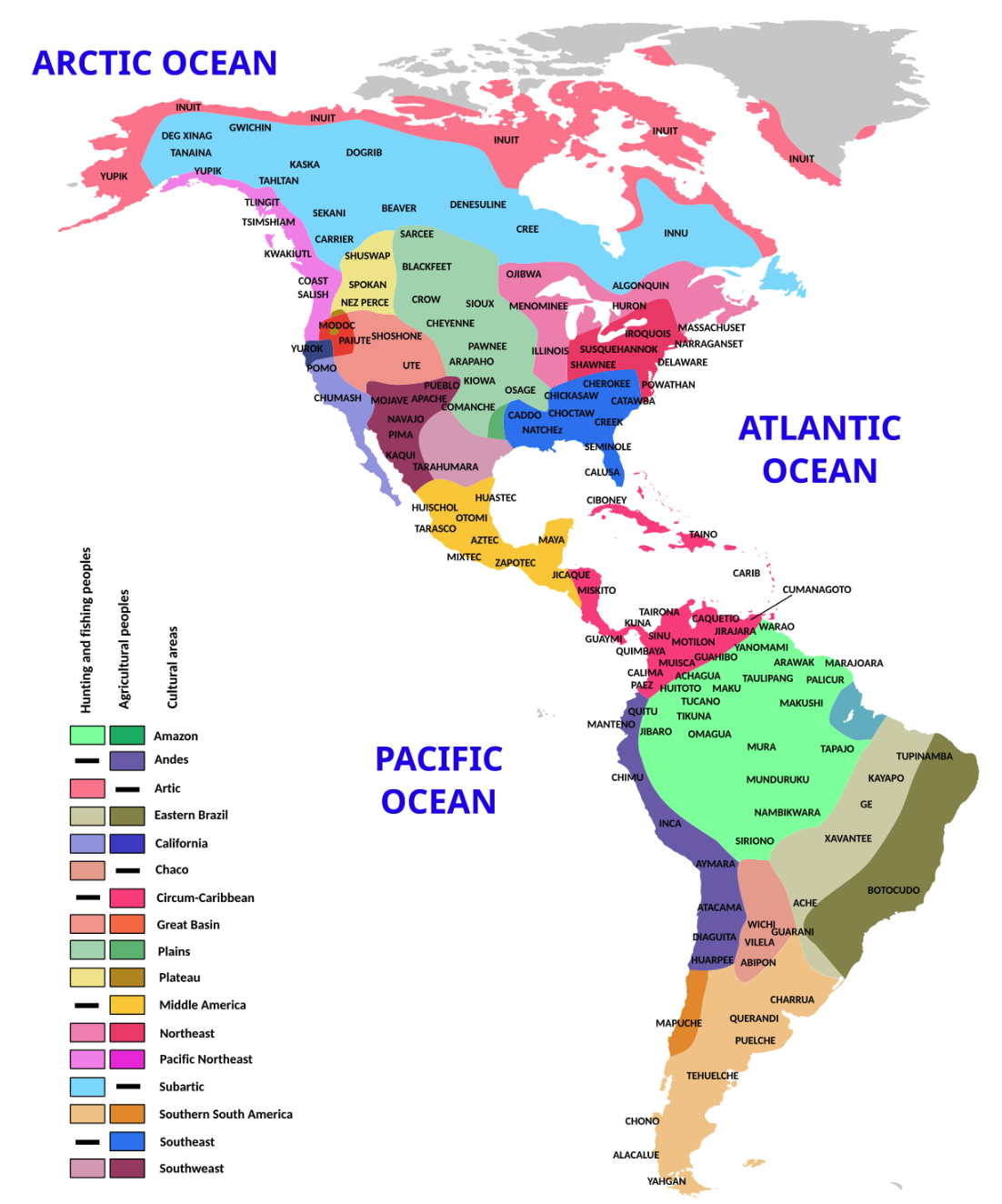
Map illustrating the diversity of Native American peoples and cultural regions
The debates surrounding October 12 highlight a reality that is sometimes overlooked by European language learners: Latin America is not exclusively Spanish-speaking or Portuguese-speaking.
Numerous Indigenous languages are still spoken throughout the region.
Quechua, Aymara, Guaraní, Nahuatl and the many Mayan languages represent linguistic traditions that existed long before 1492 and continue to evolve today.
These languages are not simply remnants of the past. They are used in everyday life, education, artistic expression and contemporary cultural movements.
Spanish words with Indigenous origins
Latin American Spanish itself reflects this linguistic diversity.
| Spanish word | Linguistic origin | Meaning in English |
|---|---|---|
| chocolate | Nahuatl, precise etymology debated | Chocolate |
| tomate | Nahuatl | Tomato |
| aguacate | Nahuatl | Avocado |
| cancha | Quechua | Sports field, court |
| puma | Quechua | Puma |
These examples show how contact between languages has enriched Spanish vocabulary.
Understanding this diversity helps us move beyond a uniform image of the Spanish-speaking world.
Learning Spanish also means understanding different historical memories
For Spanish learners, the different names given to October 12 offer an excellent starting point for exploring the cultural and historical richness of the Spanish-speaking world.
Essential Spanish vocabulary
| Spanish | English |
|---|---|
| el descubrimiento | discovery |
| la conquista | conquest |
| la colonización | colonisation |
| los pueblos indígenas | Indigenous peoples |
| la resistencia | resistance |
| la diversidad cultural | cultural diversity |
| la memoria histórica | historical memory |
| la descolonización | decolonization |
Expressing your opinion in Spanish
Spanish → English
Mientras que en Argentina se destaca la diversidad cultural, en Venezuela se recuerda la resistencia indígena.
While Argentina emphasises cultural diversity, Venezuela commemorates Indigenous resistance.
Spanish → English
Aunque se trate de la misma fecha, su significado puede cambiar según el país.
Although it is the same date, its meaning may vary from one country to another.
Spanish → English
Desde mi punto de vista, es importante reconocer las diferentes memorias históricas.
From my point of view, it is important to recognise different historical memories.
Your turn · B1–B2 level
Answer the following questions in Spanish:
- ¿Qué diferencias encuentras entre «Día de la Raza» y «Día de la Resistencia Indígena»?
- ¿Por qué crees que algunos países han cambiado el nombre de esta conmemoración?
- ¿Puede una misma fecha tener significados diferentes según el país?
- ¿Qué papel debe desempeñar la memoria histórica en la sociedad actual?
These questions can be used for an oral debate, a written assignment or preparation for Spanish-language examinations.
Frequently asked questions
Why is October 12 an important date?
It marks the arrival of Christopher Columbus’s expedition in the Caribbean on October 12, 1492, an event with major consequences for the history of the Americas and the wider world.
Does October 12 have the same name throughout Latin America?
No. Names vary depending on the country and the historical perspectives emphasised.
What does Día de la Raza mean?
It is a historical name associated with ideas of a shared Hispanic cultural community. Several countries have replaced it with names that place greater emphasis on diversity or Indigenous historical memory.
Why is Indigenous resistance commemorated?
The term recognises the different forms of resistance developed by Indigenous peoples in response to conquest and colonisation.
What is the difference between history and memory?
History studies the past using evidence and critical methods. Memory concerns the ways individuals and communities remember and interpret that past.
Does everyone commemorate October 12 in the same way?
No. Official commemorations do not necessarily reflect all the views and historical memories within a society.
October 12: a date that invites us to rethink the past
More than five centuries after Christopher Columbus arrived in the Caribbean, October 12 continues to raise questions about history and identity across the Americas.
The changes in commemorative names adopted by several countries show that societies regularly reassess their historical narratives in response to new research, political developments and social demands.
From cultural diversity and Indigenous resistance to decolonization and the encounter between worlds, the names associated with October 12 remind us that a single date can carry profoundly different meanings.
At ELE USAL Strasbourg, we believe that learning Spanish goes beyond grammar and vocabulary. Discovering the cultures, histories and contemporary realities of Spanish-speaking countries is also an essential part of learning a living language.
Explore further
To understand how October 12 is commemorated in Spain, read our article about Spain’s national holiday and Día de la Hispanidad (in French).
Would you like to improve your Spanish while exploring the cultures of the Spanish-speaking world? Discover our Spanish courses in Strasbourg (French-language page).
Sources and further reading
The following references provide access to official decisions concerning the names used for October 12 and to resources on Indigenous linguistic diversity:
- Argentina — Decree 1584/2010.
- Bolivia — Supreme Decree 1005/2011.
- Colombia — Ministry of Culture Resolution 138/2021.
- UNESCO — International Decade of Indigenous Languages.
These sources document institutional decisions and linguistic diversity. They do not imply that all communities share the same interpretation of history.
No Comments